October 26, 2026
How Microsoft, Alphabet and Amazon pay for AI capex, in their own words
How big tech pays for AI capex, from Microsoft, Alphabet and Amazon filings and calls. Cash comes first, then debt, leases and new stock.
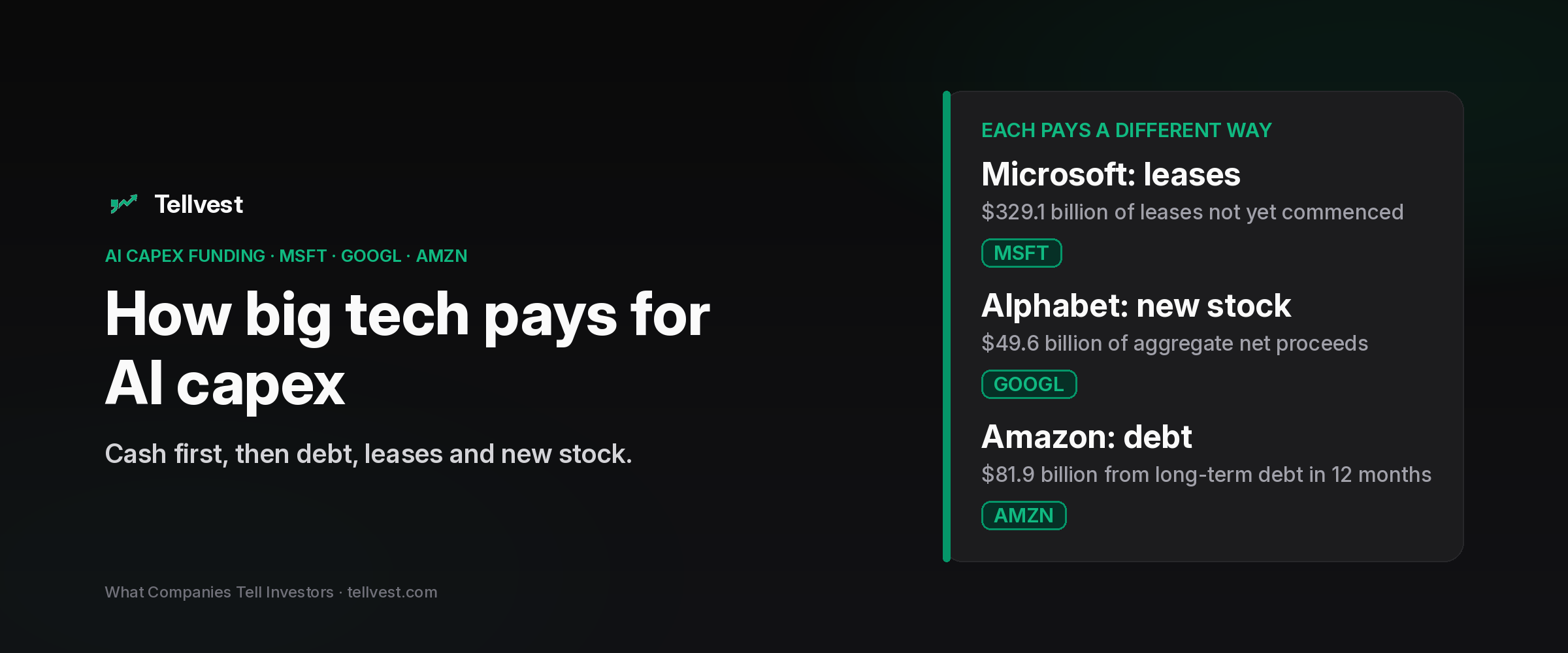
Three of the biggest AI spenders report on Oct 28 and 29, and each pays for the build a different way. Microsoft leans on leases and issued no new debt last fiscal year. Alphabet sold new stock for $49.6 billion in net proceeds. Amazon raised $81.9 billion from long-term debt in 12 months.
How big tech pays for AI capex is spelled out in Microsoft, Alphabet and Amazon's own filings and earnings calls. Operating cash comes first. Debt, leases and, at Alphabet, new stock fill in the rest. Tellvest's earlier piece covered what companies said about AI capex on earnings calls, which was about supply limits. This one follows the money.
How big tech pays for AI capex: cash first, then debt, leases and new stock
Alphabet's finance chief, Anat Ashkenazi, laid out the order on the company's July 22 call. She said, "[W]e first look at how much we can support based on cash from operations." Then: "so that's our first source of funding. And then we look at debt, and most recently we did the equity raise."
Microsoft and Amazon start in the same place. Microsoft generated $182.9 billion of operating cash in its fiscal year ended June 30, 2026, and took on no new debt that year. Microsoft's second payer is leases. Amazon generated $161.4 billion of operating cash and raised $81.9 billion from long-term debt, both in the 12 months to June 30, 2026.
How Microsoft, Alphabet and Amazon fund AI capex, side by side
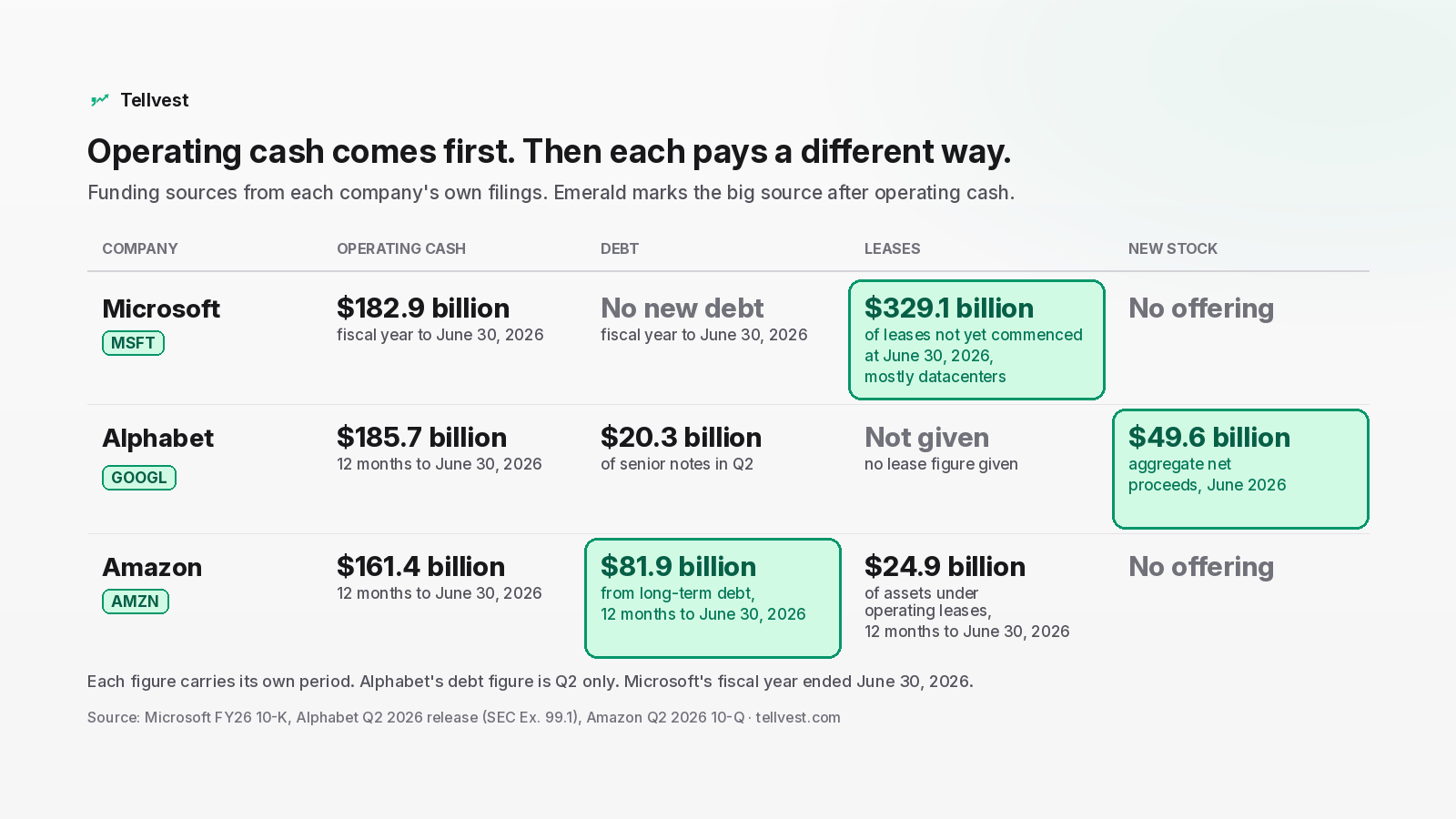
This table lists each company's funding sources from its own filings and calls. Meta is included for context.
| Company | Operating cash | Debt | Leases | New stock | Other |
|---|---|---|---|---|---|
| Microsoft | $182.9 billion, fiscal year to June 30, 2026 (10-K) | No proceeds from new debt in that fiscal year, $3.0 billion repaid (10-K) | $5.6 billion of finance leases in the June quarter (call). $329.1 billion of leases not yet commenced, mostly datacenters (10-K) | No offering. $10.2 billion returned to shareholders in the June quarter (call) | Expects to stay free cash flow positive in fiscal 2027 (call) |
| Alphabet | $185.7 billion in the 12 months to June 30, 2026 (release) | $20.3 billion of senior notes in Q2. Long-term debt $46.5 billion to $98.2 billion in six months (release) | No lease figure given. Third-party capacity in Q3 as a "bridging strategy" (call) | $49.6 billion of aggregate net proceeds in June 2026, including mandatory convertible preferred (release) | Up to $40.0 billion at-the-market program for employee stock taxes, none sold by June 30 (release) |
| Amazon | $161.4 billion in the 12 months to June 30, 2026. Free cash flow an outflow of $7.6 billion (release) | $81.9 billion from long-term debt in the 12 months to June 30, 2026 (10-Q). $25.0 billion of notes after June 30 (10-Q). £4.25 billion of notes closed Sept 14 (8-K) | $24.9 billion of assets under operating leases and $4.0 billion under finance leases, 12 months to June 30, 2026 (10-Q) | No offering reported | Commercial paper: none outstanding at June 30 (10-Q) |
| Meta (context) | $97 billion in the first three quarters of 2026 (release) | Investment-grade debt named as a source, no amount given | Not given | About $35 billion of offerings launched Oct 26, plus a planned at-the-market program of about $60 billion (release) | Strategic partnerships named as a source |
Microsoft: no new debt and more operating leases
Microsoft's cash flow statement for the fiscal year ended June 30, 2026 shows $182.9 billion of net cash from operations and zero proceeds from new debt. It repaid $3.0 billion of debt in the same year and returned $10.2 billion to shareholders through dividends and buybacks in the June quarter alone.
Leases are Microsoft's second payer. Finance leases totaled $5.6 billion in the June quarter, and CFO Amy Hood said they "were primarily for large datacenter sites." Microsoft's annual report lists another $329.1 billion of leases, "primarily for datacenters," that had not yet commenced on June 30, 2026. Those start between fiscal 2027 and fiscal 2033.
Starting in fiscal 2027, Microsoft is extending the estimated useful lives of its datacenters and office buildings from 15 to 25 years. Hood explained what that does to the lease mix and the capex figure:
"The greater impact is on capital expenditures as more of our future datacenter leases will shift from finance leases to operating leases as a result of this update. Finance leases are included in capital expenditures while operating leases are not. Outside of this useful life impact, our calendar year 2026 CapEx investment expectations remain unchanged. However, the shift from finance to operating leases adjusts our expectation to approximately $175 billion."
Hood also said Microsoft expects "to remain free cash flow positive in FY27."
Alphabet: $49.6 billion in aggregate net proceeds from new stock and no plan for another
Alphabet is the only one of the three that sold stock in an offering. In June 2026 it issued Class A and Class C shares plus mandatory convertible preferred stock. Its earnings release puts the "aggregate net proceeds" at $49.6 billion, "to be used for general corporate purposes, including capital expenditures to scale AI infrastructure and global compute."
On the July call, Ashkenazi said: "At this point, we're not planning to go back to the equity markets". The exception is an at-the-market program for "the tax on SBC," meaning taxes on stock-based pay. That program can sell up to $40.0 billion of shares, and Alphabet had not sold any as of June 30, 2026.
Alphabet's debt grew too. The company issued $20.3 billion of senior unsecured notes in the second quarter, and its long-term debt went from $46.5 billion at the end of 2025 to $98.2 billion on June 30, 2026. A year earlier, Ashkenazi said, "we were at about $16 billion," and "we went to about $100 billion across multiple currencies and geographies."
Operating cash is still Alphabet's largest source, at $185.7 billion in the 12 months to June 30, 2026. Alphabet is also leaning on other companies' capacity. The company plans "to expand the use of third-party capacity in Q3 as a bridging strategy while we build out more internal capacity," which Ashkenazi said "will create modest margin pressure in the near-term." Tellvest has a separate piece on how CoreWeave, Nebius and IREN fund their buildouts, three companies that rent out that kind of capacity.
Amazon: $81.9 billion of new debt and a free cash flow outflow
Amazon raised $81.9 billion from long-term debt in the 12 months to June 30, 2026, according to the cash flow statement in its quarterly report. Most of that, $67.0 billion, came in the first six months of 2026. Long-term debt went from $65.6 billion at the end of 2025 to $128.9 billion on June 30, 2026.
Amazon's operating cash rose 33% to $161.4 billion in the 12 months to June 30, 2026, and free cash flow was an outflow of $7.6 billion. Amazon said the outflow was "driven primarily by a year-over-year increase of $66.1 billion in purchases of property and equipment, net of proceeds from sales and incentives," and that the increase "primarily reflects investments in artificial intelligence."
CEO Andy Jassy said on the July 30 call: "We now believe we will spend approximately $220 billion in cash CapEx in 2026." He added, "Even at that amount, we will still not have enough capacity to meet all the demand we have in 2026..."
When Baird's Colin Sebastian asked CFO Brian Olsavsky about "sources of capital for the build-out," Olsavsky answered:
"You've seen us issue debt this year. We have a lot of options available to us as we continue to fund this growth that we're seeing in AWS. So we'll continue to look at all the options and make the appropriate decision at the right time, but nothing to share today."
Amazon kept borrowing after that call. Amazon's quarterly report says it issued $25.0 billion of U.S. dollar notes after June 30, and on Sept. 14 it closed a sale of £4.25 billion of sterling notes. Leases added $24.9 billion of assets under operating leases and $4.0 billion under finance leases in the 12 months to June 30, 2026. Amazon reported no stock offering.
Meta, for context: about $35 billion of stock offerings launched Oct 26
Meta reported on Oct 21. On Oct 26 it launched about $35 billion of stock offerings: about $22.5 billion of Class A shares through forward sales and about $12.5 billion of mandatory convertible preferred. It also plans an at-the-market program of about $60 billion, "not expected to commence until the first quarter of 2027." Meta said it intends to fund its investments through "a balanced mix of operating cash flow, investment-grade debt, strategic partnerships, and equity capital." Meta on Tellvest
What to listen for on cash, debt and leases, Oct 28 and 29
- Microsoft, Wed Oct 28, 4:30 PM CT: whether Hood still expects Microsoft "to remain free cash flow positive in FY27," and how fast the $329.1 billion of not-yet-commenced leases starts. Microsoft on Tellvest
- Alphabet, Wed Oct 28, 3:30 PM CT: whether Ashkenazi is still "not planning to go back to the equity markets," and what the third-party capacity cost in Q3. Alphabet on Tellvest
- Amazon, Thu Oct 29, 4:00 PM CT: whether Amazon has more to say on sources of capital than "nothing to share today," with $25.0 billion of dollar notes and £4.25 billion of sterling notes issued since June 30. Amazon on Tellvest
Tellvest tracks 500+ U.S. companies and shows a 1-10 sentiment score for every quarter. All data is sourced from SEC filings, company-reported results, and public earnings transcripts. You can find every company Tellvest covers on Browse companies.
Questions about how big tech pays for AI capex
What did Microsoft, Alphabet and Amazon say on their earnings calls about paying for AI capex?
On Alphabet's July 22 call, finance chief Anat Ashkenazi said cash from operations is "our first source of funding." She said debt comes next, and "most recently we did the equity raise." On Microsoft's July 29 call, CFO Amy Hood said Microsoft expects "to remain free cash flow positive in FY27." On Amazon's July 30 call, CFO Brian Olsavsky said, "You've seen us issue debt this year." On further sources of capital, he said there was "nothing to share today."
How does Microsoft pay for AI capex?
Mostly with operating cash and leases. Microsoft generated $182.9 billion of operating cash in its fiscal year ended June 30, 2026, issued no new debt that year, and had $329.1 billion of leases, mostly for datacenters, that had not yet commenced.
Is Alphabet selling more stock to pay for AI?
Alphabet's earnings release reports aggregate net proceeds of $49.6 billion from the new shares and mandatory convertible preferred stock it issued in June 2026. In July its finance chief said it is "not planning to go back to the equity markets," apart from a program that covers taxes on employee stock.
How much has Amazon borrowed?
Amazon raised $81.9 billion from long-term debt in the 12 months to June 30, 2026. After June 30 it issued $25.0 billion of U.S. dollar notes and £4.25 billion of sterling notes. Amazon's quarterly report says the $25.0 billion of notes are for general corporate purposes.
When do Microsoft, Alphabet and Amazon report next?
Microsoft and Alphabet report on Wednesday, Oct 28, with calls at 4:30 PM CT and 3:30 PM CT. Amazon reports on Thursday, Oct 29, with its call at 4:00 PM CT.