October 9, 2026
AI capex: demand isn't the question on earnings calls. Supply is.
AI capex keeps rising, but on their earnings calls Microsoft, Alphabet, Amazon, Meta, chipmakers, and utilities kept naming supply limits: compute, memory, and power. What they said about data center spending, and what to listen for next.
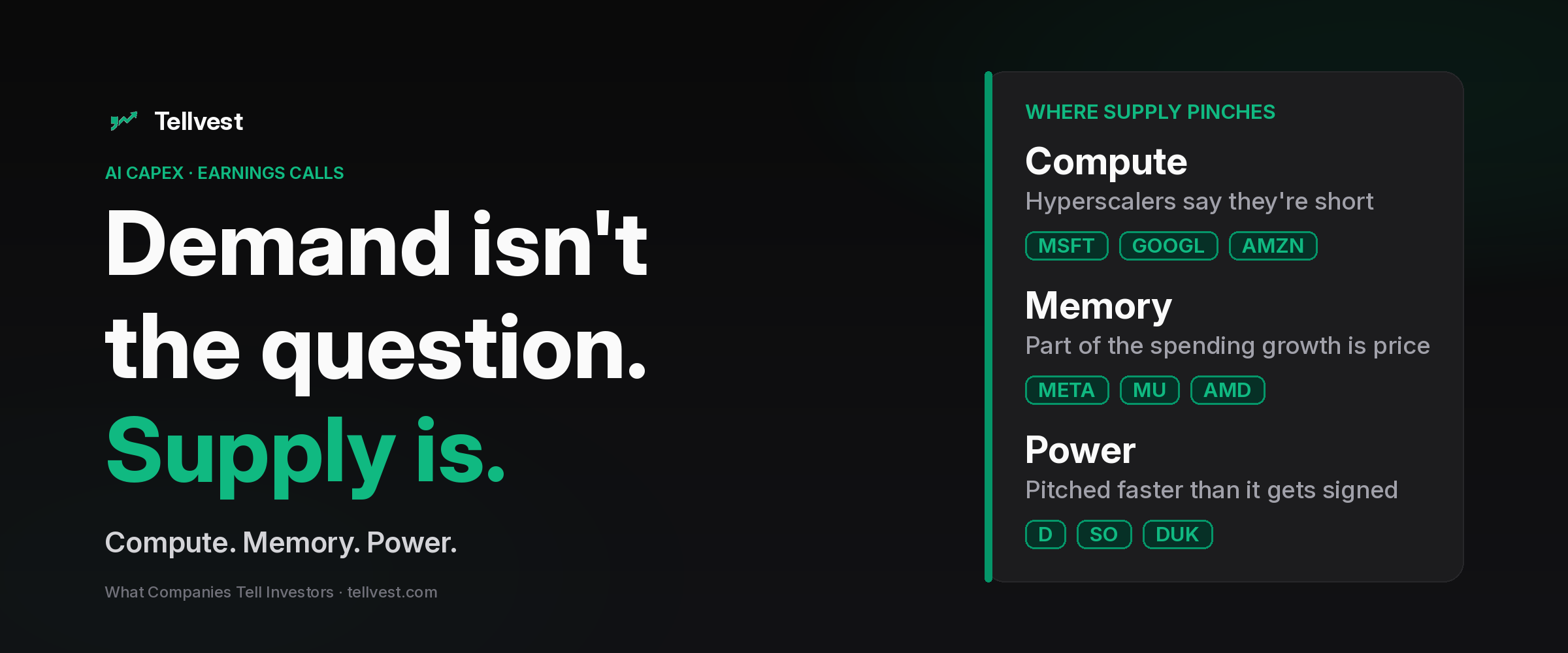
Every AI capex headline is a number. Microsoft says roughly $190 billion for calendar 2026. Amazon says about $200 billion. Meta says $125 billion to $145 billion. Each gets read as a demand gauge.
Listen to the calls, though, and almost nobody is arguing about demand. What management keeps coming back to is supply: not enough compute, memory that suddenly costs a lot more, and power that gets pitched far faster than it gets signed.
Here is what hyperscalers, chipmakers, and power companies said on their most recent free calls, held between December 2025 and June 2026, and what to listen for when the next round starts on October 28. Each company name links to the quarter quoted, so you can check the wording yourself.
Tellvest is descriptive analysis built from SEC filings, company-reported results, and public earnings transcripts. This post is not investment advice.
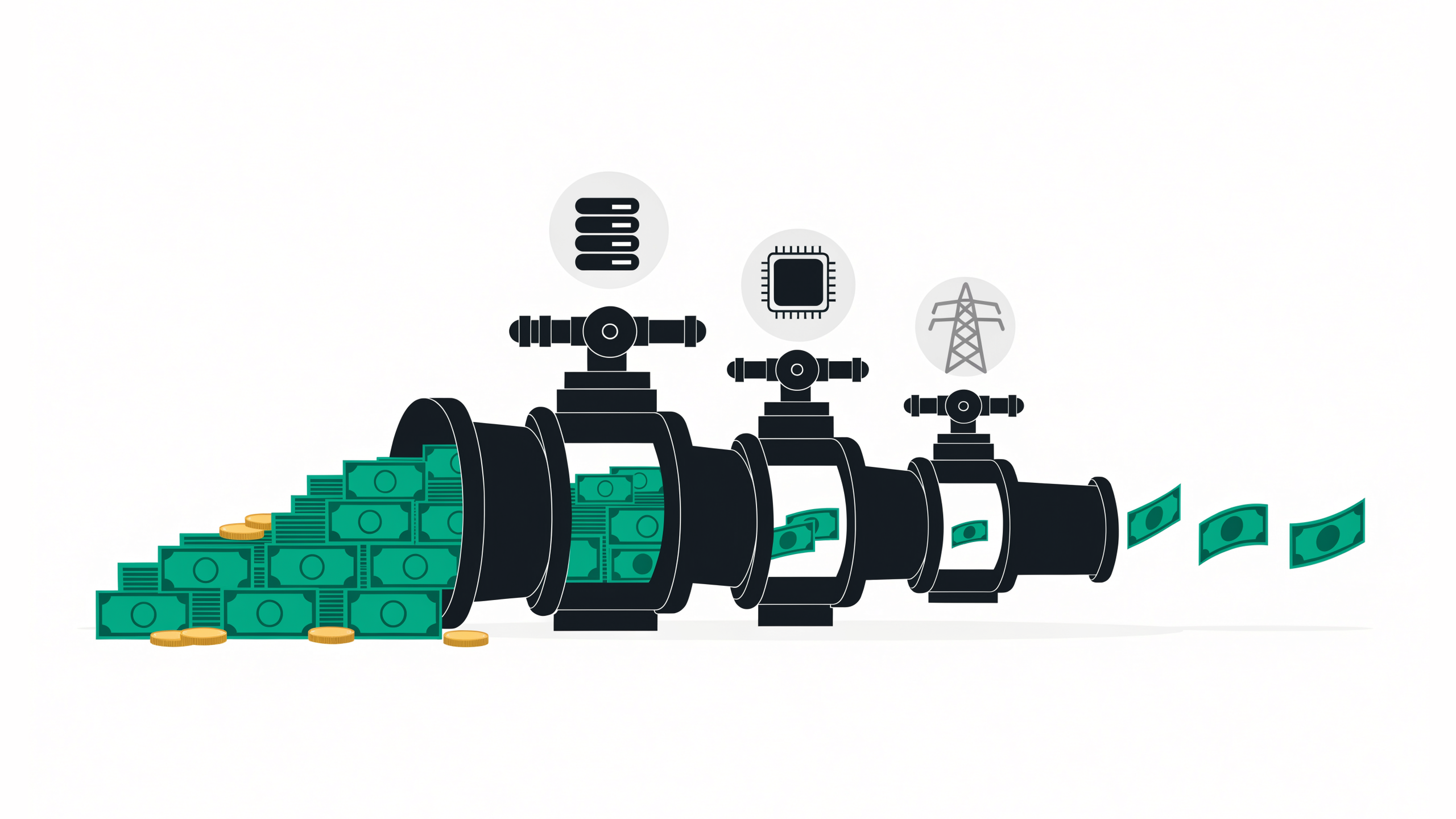
Pinch one: AI capex is rising and hyperscalers still say they're short
On its January call, Microsoft said customer demand was still running ahead of supply and capacity would stay constrained, after spending $37.5 billion in the quarter. Quarterly capex dipped to $31.9 billion by the April call, a drop it had already tied to finance lease timing, and it put calendar 2026 at roughly $190 billion.
Alphabet told a similar story in April: compute constraints were limiting cloud revenue, and it expects 2027 capex to rise significantly.
Amazon said in February that it plans about $200 billion of capex, mostly for AWS, and that new capacity was being monetized as fast as it was installed.
When a company spending at this scale says it is capacity constrained, a higher capex number says more about how hard capacity is to get than about whether customers want it.
Pinch two: data center capex has a memory bill inside it
Some of the increase in AI capex isn't more servers. It's the same servers costing more.
On its April call, Microsoft said its roughly $190 billion figure includes $25 billion from higher component pricing. Meta guided 2026 capex, including finance lease principal payments, to $115 billion to $135 billion on its January call. On its April call, it raised that to $125 billion to $145 billion, pointing to higher component pricing, particularly memory, plus extra data center costs. The same day, Amazon described memory costs that had soared, with too little capacity to meet demand.
The supplier confirms it. Micron said on its December call that industry memory supply would stay substantially short of demand, and raised its fiscal 2026 capex plan to about $20 billion. In March that became more than $25 billion. On its June call, Micron put it at about $27 billion, said DRAM prices rose in the low 60s percentage range, reported gross margin of 84.9%, and said it expects tight conditions to last beyond calendar 2027.
The bill lands on consumers too. AMD said in May it expects lower second half PC shipments and gaming revenue down more than 20% from the first half, citing memory and component costs. NVIDIA said in May that consumer demand fell modestly on higher memory and system prices.
So when a capex guide goes up, ask how much buys new capacity and how much pays more for the same capacity. Microsoft and Meta told you part of the answer.
The chip orders are real, and they're sized in gigawatts
NVIDIA reported data center revenue of $75 billion on its May call, up 92% from a year earlier. Broadcom said in June: "AI semiconductor revenue at a record $10.8 billion, up 143% year on year."
On its April call, Meta described "rolling out more than 1 gigawatt of our own custom silicon that we're developing with Broadcom," alongside a "significant amount of AMD chips to complement the new NVIDIA systems that we're rolling out as well." Amazon, which builds its own chips, said it will still "continue to order substantial quantities" from NVIDIA. You can follow references like these in Mentions.
Look at the unit, though. Broadcom described new commitments of 5 gigawatts from Anthropic, 1.3 gigawatts from OpenAI, and 3 gigawatts from Meta. AMD described a Meta deal for up to 6 gigawatts of its GPUs. Chip deals are now quoted in the unit a power company uses. That is where the third pinch sits.
Pinch three: power is pitched in tens of gigawatts and signed in fewer
Utilities describe data center demand in two numbers: what is in the pipeline and what is under contract. The gap between them is the clearest supply signal in the chain.
Dominion said in February that over 48 gigawatts were in various stages of contracting. On its May call, it described "over 50 gigawatts of data center capacity in various stages of contracting, including approximately 10.4 gigawatts of capacity contracted under electrical service agreements."
Southern Company said in February that its "total large load pipeline has increased to over 75 gigawatts," with 10 gigawatts fully contracted. By April, contracted load passed 11 gigawatts after 1.9 gigawatts of new hyperscaler contracts in two months. Duke Energy said in May it had brought "total executed agreements to approximately 7.6 gigawatts," against a late-stage pipeline of 15.4 gigawatts.
American Electric Power is the outlier, citing an "incremental contracted total of 63 gigawatts expected by 2030," nearly 90% of it data centers. In one region, it said new contracted load was "driven primarily by an Amazon data center project in Northwest Louisiana." Its friction is the grid. On the same May call, management said it was assessing every option, including alternatives to its membership in the PJM grid, if PJM can't connect new generation to load faster.
Power producers show the same push and pull. Constellation acknowledged in March that a hyperscaler deal it had signaled was not ready to announce. By May, it said PJM clarity was coming faster than hoped, while Texas forward prices stayed weak despite a strong data center pipeline, with the timing of new load uncertain. Vistra closed the loop in May, citing "long-term power purchase agreements with Meta for approximately 2,600 megawatts of energy and capacity at our PJM nuclear sites."
None of this says the pipelines are wrong. The slow step is turning interest into signed, connected power.
Big tech AI spending, read from both ends
Side by side, the layers agree on demand. Hyperscalers say they are short, chipmakers report the orders, and most utilities carry pipelines well beyond what they have signed. The open question is supply and timing, and part of the spending growth is price. That changes what a capex raise means. It can buy more capacity, pay a higher bill for the same capacity, or both, and the calls are where companies say which.
What to listen for on the next calls
The summer calls are already in, and the newest quarter on each company page is in Pro. The next round starts October 28:
- Hyperscalers: Microsoft, Alphabet, and Meta on October 28, Amazon on October 29. Do they still say they are capacity constrained? When capex guidance moves, how much do they put on component pricing?
- Utilities and power producers: AEP on October 28, Dominion on October 30, Southern and Duke on November 5, Vistra on November 6, Constellation on November 9. Does contracted load close any of the gap with the pipeline? Does the talk about grid connection speed change?
- Chips: AMD on November 3, NVIDIA on November 18. Does the memory squeeze on PCs, gaming, and consumer devices widen or ease?
Dates are the estimates shown on each company page and can move.
How to follow it yourself
- Pick a layer you follow, or browse companies.
- Open a company page and compare the capex, supply, and demand themes quarter to quarter, in management's words.
- Use the Economic Sentiment Index for capex signals across companies, and Mentions to see who names whom.
For another cross-company rollup, see what retailers said they did with tariff refunds.
See the Economic Sentiment Index
Related: Blog, How to follow earnings without reading every transcript, How to read cross-company Mentions.