October 8, 2026
What retailers said they did with tariff refunds
What Walmart, Costco, Home Depot, Target, Ross, and Williams-Sonoma told investors they did with tariff refunds on Q3 2026 earnings calls: reinvested in price, offset costs, booked into EPS, or kept out of non-GAAP results.
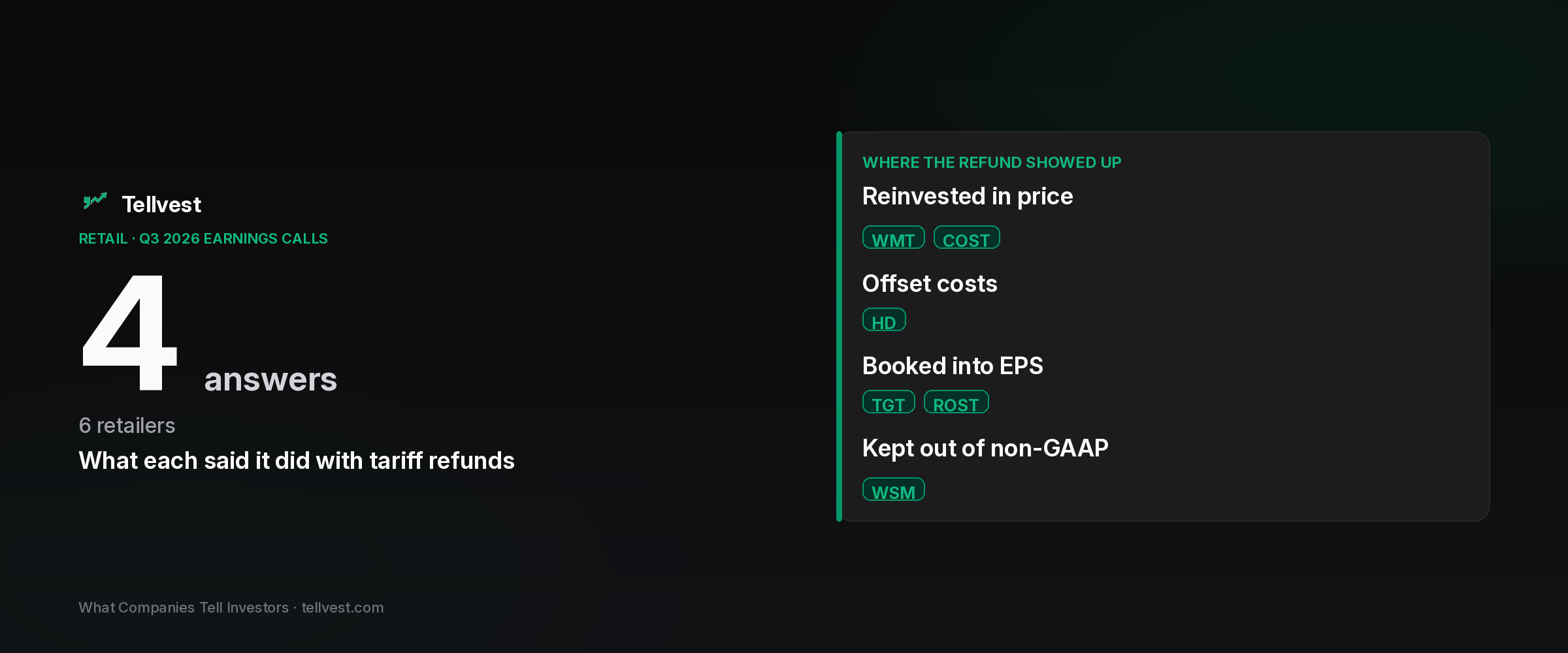
Tariff refunds came up on one retail earnings call after another this season. Headlines turned it into one question: who kept the money, and who gave it back?
Those two verbs hide at least four different things. Two retailers cut prices. One used the money to cover rising costs. Two counted it in earnings per share. One left it out of its adjusted results. Press coverage blurs it further when it says a company will "issue refunds" to shoppers and the call describes something else.
Here is what six retailers told investors on their calendar Q3 2026 calls, sorted by what each said it did, in its own words. Each company name links to its Tellvest page, where you can follow the Trade & Tariffs signal across quarters.
Tellvest is descriptive analysis built from SEC filings, company-reported results, and public earnings transcripts. This post is not investment advice, and it takes no position on tariff policy.

Six retailers, four answers
| Company | What it said it did | Figure |
|---|---|---|
| Walmart (WMT) | Reinvested in price | About $2.9B in refunds; rollbacks from 7,200 to more than 11,000 |
| Costco (COST) | Reinvested in member prices | $184M received |
| Home Depot (HD) | Offset costs | $685M against cost of goods sold |
| Target (TGT) | Booked into earnings per share | $1.65 of $4.11 EPS |
| Ross Stores (ROST) | Booked into earnings per share | About $0.60 of $2.66 EPS |
| Williams-Sonoma (WSM) | Kept out of non-GAAP results | $174M recognized as income |
The figures in the last column come from the quarter each company reported this season. Earlier quarters on each company page are free. For the market-wide view of the same season, see the Q3 2026 Earnings Pulse.
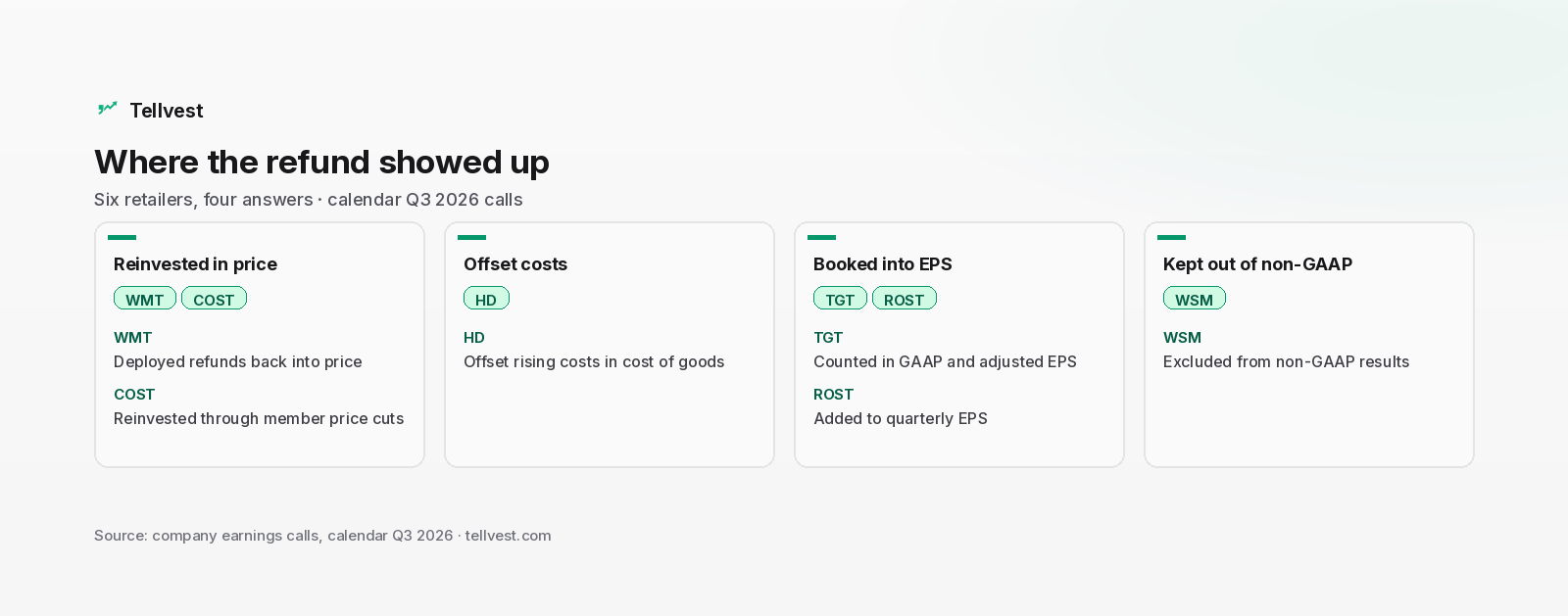
Reinvested in price: Walmart and Costco
Walmart. Management said on the call that "our intent was to deploy much of that back into price, and that's what we're doing." The CFO described "investing these funds back into customer experience and price leadership, prioritizing investment in grocery and general merchandise categories." Walmart U.S. went from 7,200 rollbacks at the end of the first quarter to more than 11,000, on refunds of about $2.9B. Walmart also asked investors to look at its second and third quarter operating income together.
Costco. Here press and call diverge. Some coverage said Costco would issue tariff refunds to consumers. The call described price cuts. Management said it reinvested some of the dollars "to give value back to our members," "predominantly through price reductions" on items in produce, meat, beverages, home furnishings, and hardware. CFO Gary Millerchip said Costco received $184M in the quarter and intends "to continue reinvesting the majority of the dollars we receive in increased member values." Costco also reported a non-recurring earnings benefit from the refunds, net of that reinvestment, and said it will report the net impact on future calls. Its free FY2026 Q3 view already carries a "Tariff Refund Claims Under Way" card from before the money arrived.
Walmart, Costco, and Target also sit side by side on the Discount Stores industry page.
Offset costs: Home Depot
Home Depot. CFO Richard McPhail said $685M reduced cost of goods sold for products already sold, and that "those benefits offset increased costs that we've seen in our cost base." He added that pressure from "fuel, energy and other product input costs" is expected to "fully offset the benefit from tariff refunds over the year." Home Depot framed the refund as cover for higher costs rather than a lasting margin gain.
Booked into earnings per share: Target and Ross
Target. On the call: "Tariff refunds contributed $1.65 to EPS," out of $4.11 for the quarter. Target counted the benefit in both GAAP and adjusted EPS, then told investors it was focused on "adjusted EPS, excluding the tariff refunds" to judge the underlying business.
Ross Stores. Ross said the refunds added about $0.60 to its $2.66 in quarterly EPS. "Excluding this benefit, operating margin increased 205 basis points". Ross also included the same $0.60 in its full-year EPS forecast.
"Booked into EPS" describes where the money showed up in the reported numbers. Pricing at either company is a separate question.
Kept out of non-GAAP results: Williams-Sonoma
Williams-Sonoma. The company recognized $174M of refund income. On the call, management said: "These refunds are one-time and material, so we have excluded them from our second quarter non-GAAP results, and we plan to do the same in the third quarter." Part of the money went to reimburse vendors who had given tariff discounts, and part to a one-time 401(k) contribution for employees. Its GAAP results carry the refund. Its non-GAAP results and guidance leave it out.
Why "kept" and "gave back" fall short
Target and Williams-Sonoma both recognized refund income. Target included it in adjusted EPS. Williams-Sonoma took it out. That reporting choice changes what the headline number shows. Both choices are different acts from Costco cutting member prices or Home Depot covering higher costs.
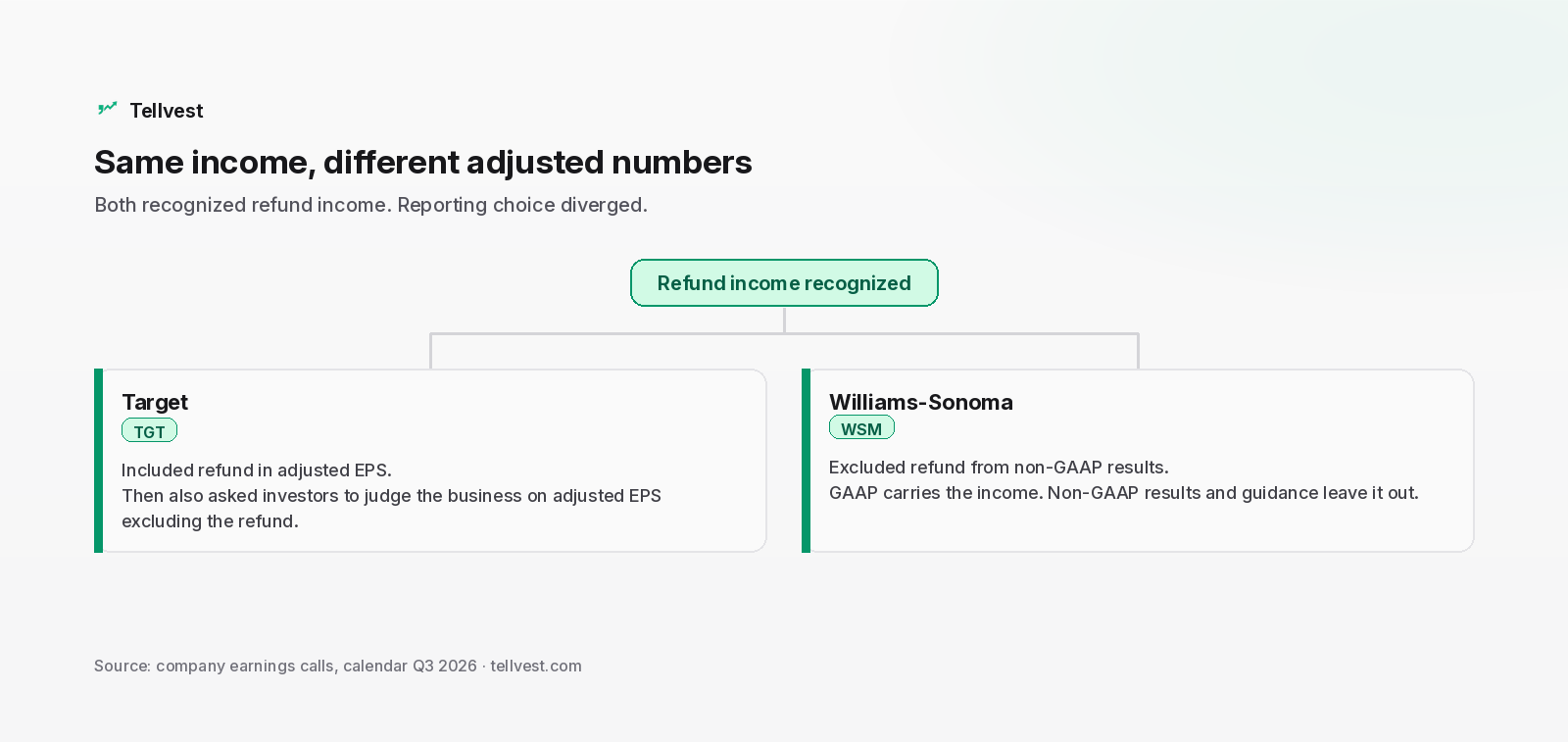
You should be able to see which of those a company you follow actually did without reading every transcript.
How to follow it next quarter
- Pick a retailer from the table, or browse companies.
- Open its Tellvest page and follow the Trade & Tariffs signal across quarters. Read the themes and quotes in management's words.
- Dig deeper where the wording or a reported figure matters. Use Pro when you need the newest quarter.
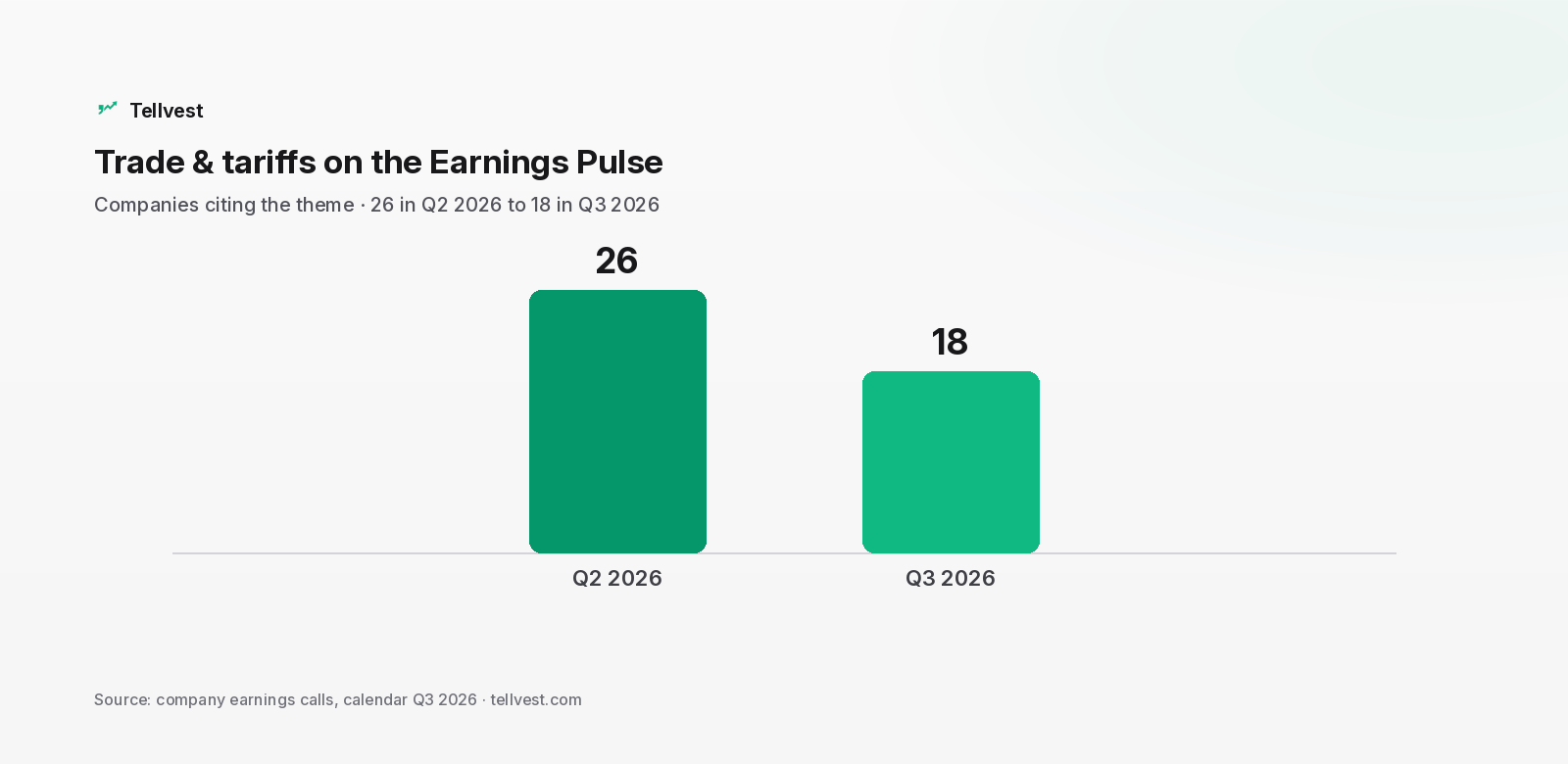
Expect the topic to keep moving. In the Q3 2026 Earnings Pulse, Trade & tariffs was a theme for 18 companies, down from 26 the quarter before. Costco and Walmart both said refund effects will carry into later quarters.
For how these same companies describe their shoppers, see what companies say about the consumer on earnings calls.
Outside retail, FedEx (FDX) and Deere (DE) also carry a Trade & Tariffs signal on their pages.
Common questions
Are retailers passing tariff refunds to consumers? Walmart and Costco described it in price terms: they said they reinvested refund dollars in price and member values. Home Depot said the refunds offset rising costs. Target and Ross reported them in earnings per share. Williams-Sonoma excluded them from its non-GAAP results.
Where can I check what a company said about refunds? On its Tellvest company page. Follow the Trade & Tariffs signal and read the themes and quotes in management's words. Earlier quarters are free. The newest quarter is in Pro.
See the Economic Sentiment Index
Related: Blog, Discount Stores, Track the same segment language across the last 4-6 earnings calls.