Start 30 days free, no card. Full Pro access for a month, then decide. Start free
“The consumer is resilient.” Which consumer?
Earnings calls and headlines keep repeating the same line: the consumer is resilient. Or under pressure. Or both in the same hour.
That line is not one national story. The same call often splits the consumer (a nationwide or macro claim) from our consumer (this company’s shoppers). Income-cohort words get buried. Viral posts sometimes attach shopper-data numbers to the call when those numbers came from somewhere else.
You can learn a short reading habit for that consumer talk without living in every transcript. Open a free prior-quarter company page (or the public transcript), separate the national claim from the company claim, listen for cohort words, note prepared remarks versus Q&A, and check the transcript before you repeat a viral number.
Tellvest is descriptive analysis for research and informational purposes only. It is not investment advice. This guide is not a macro forecast, and it does not argue for or against a “K-shaped” economy.
Why the slogan is not enough
If you only hear “the consumer is resilient,” you miss who the company meant. Retail, restaurant, and grocery calls this season have described split shoppers: need-based buying here, holding up there, trade-down in one income band and stability in another.
If you research only from headlines or a feed, you can also repeat a claim that was never said on the call. That is how research attention turns into noise.
You should not need to read thousands of transcripts (or trust a viral post) to know what this company said about its shoppers.
The habit in three steps
- Pick a company you invest in or follow that talks about shoppers or demand. Open the latest free prior-quarter company page on Tellvest, or open the public transcript if you prefer the primary file.
- Separate “the consumer” from “our consumer.” Listen for income-cohort words: need-based buying, trade-down, smaller packs, value, SNAP, fuel, confidence. Note whether the line landed in prepared remarks or under analyst questions.
- Before you repeat a viral number, check whether it was said on the call. Dig deeper only where the wording, guidance, or Q&A pressure matters. Use Pro when you need the newest quarter and forward-looking tools.
You run the habit. Tellvest supplies comparable company pages and structured layers (themes, quotes, analyst pressure) so you are not lost in raw transcript dumps.
Words to listen for
When management talks about shoppers, the useful signal is often in the modifiers, not the slogan.
- Need-based / on need: shoppers buying what they need and trimming the rest.
- Trade-down: moving to cheaper brands, formats, or channels.
- Smaller packs / value: pack size, promotions, or entry price points as the pressure valve.
- SNAP, fuel, confidence: budget pressure named as a driver, not just “soft demand.”
- Our consumer / our guest / our customer: the company’s own cohort claim, which can diverge from “the consumer” in the same remarks.
Also note where the line landed. Prepared remarks are the story management chose to lead with. Analyst Q&A is where pressure, follow-ups, and hedges often show up. Both matter. They are not the same layer of the call.
What companies have been saying (illustrative anchors)
These are hand-checked illustrations of company-specific consumer talk. They are not Tellvest scores, and they are not a ranked scoreboard.
Kroger (KR), 9/11/2026 call. Management said customers remained under pressure, cited reductions in SNAP benefits, higher fuel prices, and softer consumer confidence, and said customers are “buying more on need.” Kroger also cut full-year identical sales without fuel guidance to a range of 0.2% to 0.8% (from 1% to 2%). Primary: Kroger Q2 2026 transcript and IR release.
Dick’s Sporting Goods (DKS), 9/14/2026 Goldman Sachs conference. CEO Lauren Hobart said the consumer across the country is under pressure, but “the DICK’S consumer is holding up very well,” with growth across income demographics and no trade-down from best to better. That is the “our consumer” pattern in one breath: a national claim and a company claim that do not have to match. Primary: Goldman Sachs conference transcript.
Cracker Barrel (CBRL) and AutoZone (AZO). Recent call coverage describes income splits: higher-income strength versus lower-income softness at Cracker Barrel, and pressure on lower-income DIY customers at AutoZone. Use those as cohort-word practice, then open the free prior-quarter page (or transcript) for the exact wording.
McDonald’s (MCD), 9/23/2026 investor day. CEO Chris Kempczinski said low-income consumers, defined as U.S. households making $45,000 or less, still go out for fast food, but not as often as they used to. Coverage: ABC News / AP.
Walmart (WMT), BofA meetings. Management described the consumer backdrop as stable, citing solid back-to-school results, and said the pronounced trade-down behavior seen in the 2022 oil shock had not yet shown up, aided by wage growth and labor-market conditions. Coverage: Yahoo Finance summary of the BofA note.
None of these examples invent a Tellvest score for the company. They show why “the consumer” on a call is company-specific.
Accuracy lesson: the Kroger 700,000 claim
A widely shared claim said Kroger told its earnings call it lost 700,000 lower-income households.
That figure is not call language from the 9/11/2026 Kroger transcript. It is Numerator shopper data reported via Progressive Grocer (and related Numerator coverage): roughly 700,000 lower-income households lost over the 12 months ended July 31, 2026, alongside gains in higher-income households.
Shopper-panel data can still be useful research. The habit is simpler: before you repeat a viral number as “what they said on the call,” open the transcript (or the free prior-quarter company page) and check who said what.
Counterweights: stay neutral on the K
Retail calls are not the only evidence people cite. Stay honest about disagreement.
In July earnings season, large consumer lenders pushed back on a clean K-shaped story in their own books. A later Condor Capital summary (8/14/2026, background only) quotes JPMorgan and Capital One leadership saying they do not see much support for the K-shape narrative in their numbers, with an important caveat that lenders often see less of the lowest end of the market. Source: Condor Capital.
The Minneapolis Fed’s review of spending data reaches a similar caution: available measures “do not align to tell a clear, K-shaped story.” Source: Minneapolis Fed.
This page does not crown a letter. It teaches you to read what this company said about its shoppers, then decide what else to check.
Where to run the habit on Tellvest
- Open Browse companies and pick a name you invest in or follow (for example KR, WMT, or MCD).
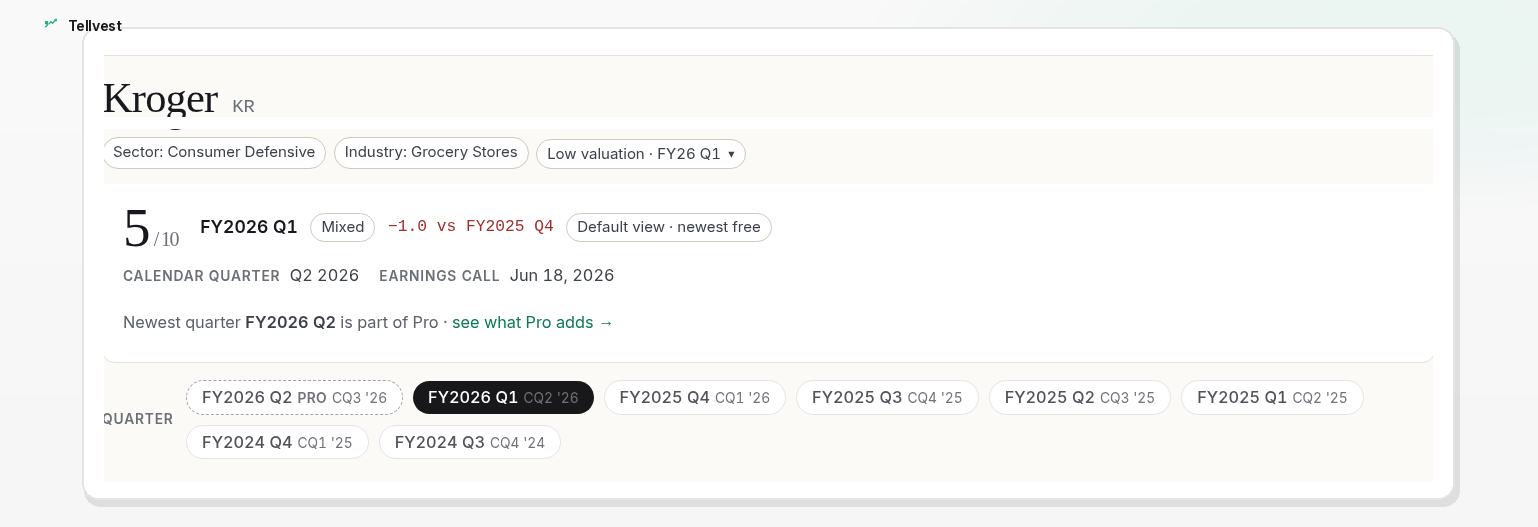
- On the company page, open a free prior-quarter chip.
- Use the structured layers for that quarter: themes and quotes are the fastest map for consumer talk. Dig into the transcript or filing only where those layers (or a viral claim) say it matters.
As on Pricing and About: prior quarters are free to browse; the newest quarter is part of Tellvest Pro. You do not need Pro to run this habit on free prior quarters. Use Pro when you need the newest quarter and forward-looking tools.
No account is required to browse free prior quarters.
For a wider economy or sector backdrop after the habit, see the Economic Sentiment Index. That is optional context, not a substitute for reading what one company said about its shoppers.
What you lose if you skip the check
- You treat “the consumer is resilient” as one story and miss what this company said about its shoppers.
- You research off headlines or viral posts and repeat a number that was never said on the call.
- You burn hours in transcripts without a simple check for income-cohort words and prepared remarks versus Q&A.
What success looks like
After a few runs, you can point to what a company said about its shoppers (and which cohort), whether it came in prepared remarks or Q&A, and whether a viral claim matches the transcript. You leave the call with company-specific consumer talk, not a slogan.
FAQ
What do companies say about the consumer on earnings calls?
It depends on the company. Many retail, grocery, and restaurant calls repeat a national line ("the consumer is resilient" or "under pressure"), then describe their own shoppers with more detail: need-based buying, trade-down, value, SNAP or fuel pressure, or an explicit "our consumer" claim that diverges from the nationwide line. The useful read is company-specific. Open a free prior-quarter company page or the transcript and check who said what.
How do you tell "the consumer" from "our consumer" on a call?
Listen for scope. "The consumer" is often a macro or industry claim. "Our consumer," "our guest," or "our customer" is this company's cohort. Both can appear in the same prepared remarks. Note the difference, then listen for income-cohort words that make the split concrete.
What income-cohort words show up in consumer talk on earnings calls?
Common ones include need-based buying, trade-down, smaller packs, value, SNAP, fuel, and confidence. Also watch for income bands named outright (for example households at $45,000 or less). Treat those as research flags for further reading, not as a macro thesis.
Did Kroger say on its call that it lost 700,000 lower-income households?
No. That figure is Numerator shopper data reported via Progressive Grocer and related coverage, not language from Kroger's 9/11/2026 earnings call. On the call, Kroger talked about customers under pressure, SNAP, fuel, softer confidence, and need-based buying, and it cut identical-sales guidance. Always check the transcript before you treat a viral number as call language.
Is "K-shaped" the only way to read consumer talk?
No. Some retail calls describe income splits. Large lenders have pushed back on a clean K in their own numbers, and the Minneapolis Fed says spending data do not tell a clear K-shaped story. Stay neutral. Read what each company said about its shoppers, then weigh other evidence separately.
Is this investment advice?
No. Tellvest provides descriptive analysis for research and informational purposes only. It is not investment advice. This guide teaches a reading habit for consumer talk on earnings calls. It is not a forecast of the economy or of any stock. Past performance does not predict future results. See About.
Are prior quarters free?
Yes. Prior quarters are free to browse on company pages. The newest quarter is part of Tellvest Pro. Details: Pricing and About.
Pick a company that talks about shoppers. Open a free prior-quarter page. Separate “the consumer” from “our consumer,” listen for cohort words, note prepared remarks versus Q&A, and check the transcript before you repeat a viral claim.
Browse companies
See the Economic Sentiment Index
Related: Pricing, About, How to browse earnings-call scores without Pro, Track the same segment language across the last 4-6 earnings calls, How to read the Economic Sentiment Index.
Tellvest provides descriptive analysis built from SEC filings and public earnings transcripts. Not investment advice.