Start 30 days free, no card. Full Pro access for a month, then decide. Start free
How to read Tellvest's Economic Sentiment Index
You follow U.S. public companies. Sometimes you need the market-wide read first: what corporate America is signaling this quarter across earnings calls, not only one ticker.
On Tellvest, that market-wide read lives on Economy. The headline number is the Economic Sentiment Index (ESI): a composite 1–10 score aggregated across analyzed companies, paired with a macro signal heatmap, a Macro Backdrop from FRED hard data, and a “What the Fed is saying” summary from the latest FOMC. For a shareable quarterly snapshot, open Earnings Pulse.
Tellvest is descriptive analysis for research only. It is not investment advice.
What the Economic Sentiment Index is (composite across companies, 1–10)
From About: the Economy dashboard shows the Tellvest Economic Sentiment Index, a composite score aggregated across all analyzed companies, alongside a macro signal heatmap showing which signals are improving or deteriorating and how broadly they are being discussed.
Each covered company already has a per-call 1–10 earnings-call sentiment score. ESI rolls those company scores into one economy-wide reading on the same 1–10 scale. A score of 1 is a weak quarter. A score of 10 is a strong one. On the homepage, the ESI module frames it as the whole market.
ESI is the bottom-up composite. The same Economy page also surfaces:
- A macro signal heatmap built from themes CEOs discuss on calls (consumer spending, AI and technology investment, capital expenditure, supply chain, trade and tariffs, inflation, employment, and more), each with a direction such as improving, stable, deteriorating, or mixed.
- A Macro Backdrop of official hard data from the Federal Reserve’s FRED.
- A “What the Fed is saying” summary of the most recent FOMC decision and press conference.
That pairing is the point: bottom-up earnings-call sentiment next to top-down public macro data and a Fed summary, not a substitute for reading any single company call.
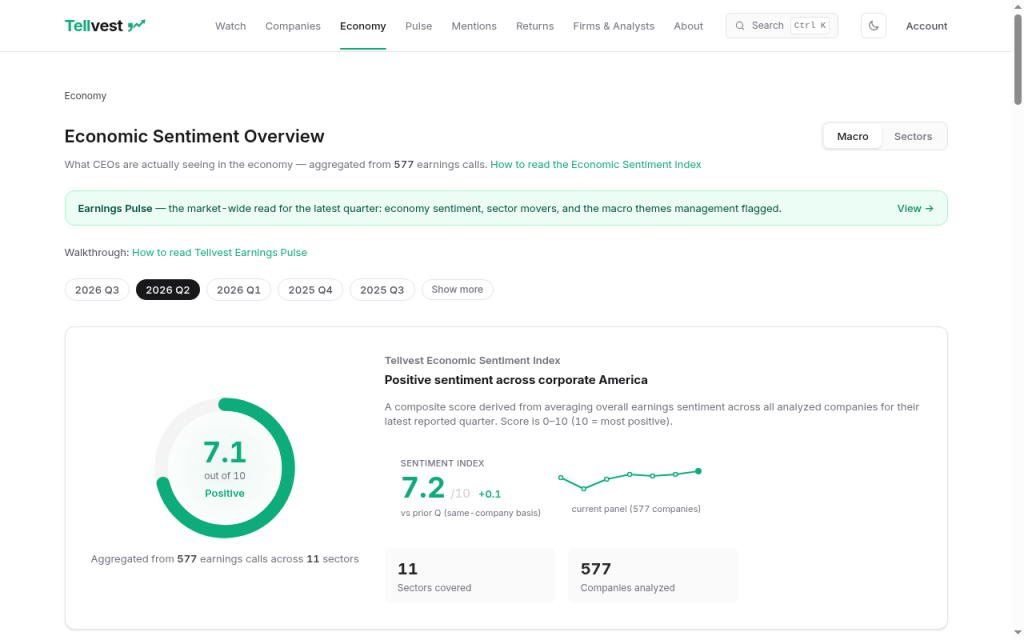
Open Economy and find the current ESI reading
- Open Economy (or use See the Economic Sentiment Index from the homepage ESI module).
- Read the economy-wide average line at the top of the page.
- Use the quarter selector to move across calendar quarters. Tellvest normalizes company fiscal periods to calendar quarters so Economy compares calls that cover roughly the same real-world window (About).
- Confirm the live figure before you cite it elsewhere; aggregates can move as more calls are processed.
Live Economy reading:
As of 2026 Q2, the Tellvest economy-wide average earnings-call sentiment across 500+ U.S. public companies is 7.1/10.
Live homepage ESI card: ESI · Q2 '26 · 7.1/10 · +0.1 vs prior Q.
The Economy and homepage ESI line is the 500+ company average. The Pulse page publishes a same-quarter reading labeled across 577 companies (see below). Cite Economy or Pulse by name when you compare them.
Economy also links a banner into Earnings Pulse as the free market-wide read for economy sentiment, sector movers, and macro themes management flagged.
Read the macro signal heatmap
On Economy, after the ESI headline, use the Macro / Sectors toggle and the quarter selector to inspect the macro signal layer for that calendar quarter.
From About: Tellvest extracts macro-economic signals from each earnings call across a standard set of categories (consumer spending, AI and technology investment, capital expenditure, supply chain conditions, trade and tariffs, inflation, employment, and more). Each signal has a direction (improving, stable, deteriorating, or mixed). Aggregated across hundreds of companies, the heatmap shows which signals are improving or deteriorating and how broadly they are being discussed.
How to read it in practice:
- Pick the calendar quarter you care about.
- Scan which themes are widely discussed versus thin.
- Note direction (improving vs deteriorating vs mixed or stable), not only mention count.
- Compare to the prior quarter on Economy’s trend views when you want to see which signals are strengthening or fading (About).
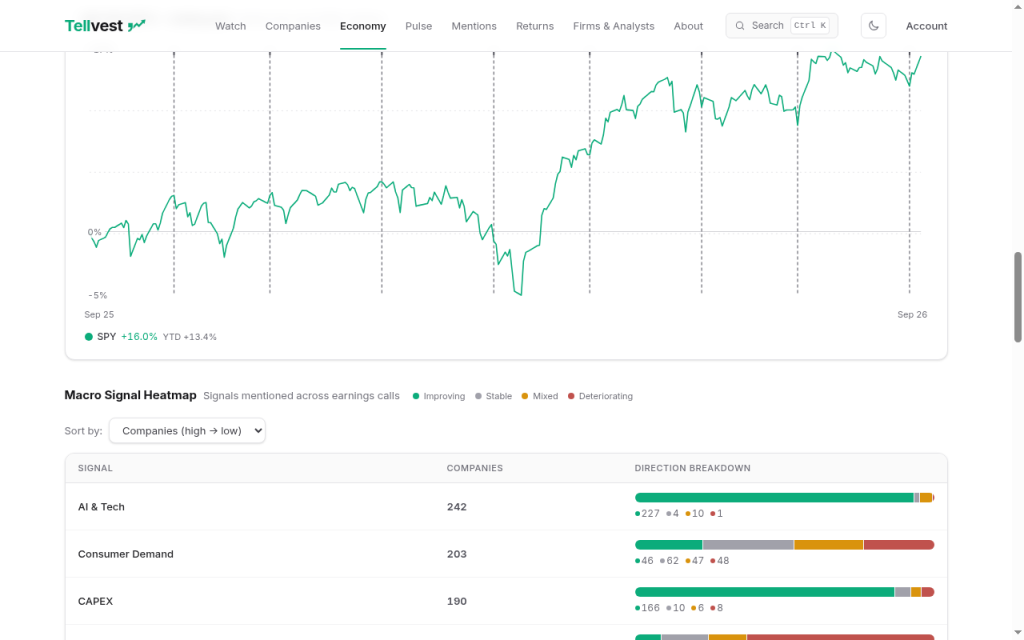
Open the live Economy page for the current quarter’s heatmap. For a shareable theme snapshot of one finished quarter, use Pulse.
Pair with Macro Backdrop and “What the Fed is saying” (FRED / FOMC; not a substitute for official Fed releases)
Still on Economy, scroll to Macro backdrop.
Live page label: Public economic data (FRED), rate-of-change · as of Jun 2026. Economy shows indicators such as Real GDP, industrial production, Core PCE, Headline CPI, unemployment, jobless claims, net liquidity, M2 money supply, Fed funds (current), and the 2-year Treasury, each as latest level and year-over-year rate-of-change.
Economy’s own disclaimer on that block:
Key economic indicators shown as latest level and year-over-year rate-of-change. Public data (FRED). Descriptive reference only, not investment advice.
About also describes a “What the Fed is saying” summary of the most recent FOMC decision and press conference on the same Economy dashboard. The SPY trailing-year chart on Economy marks FOMC meeting dates with dashed rules for context only.
Important: Tellvest’s Macro Backdrop and “What the Fed is saying” blocks are descriptive reference layers on Economy. They are not a substitute for official Federal Reserve releases, FOMC statements, minutes, or press conferences. For policy text and official decisions, use the Fed’s own publications. Tellvest does not replace those sources.
Use the pair this way: ESI and the heatmap show what management teams reported on calls; Macro Backdrop and the Fed summary show the public hard-data and policy backdrop on the same page. That is research context, not a trading signal.
When to open Earnings Pulse for the shareable quarterly snapshot
Open Earnings Pulse when you want a single, shareable quarterly snapshot rather than the full Economy dashboard.
From About: Earnings Pulse distills each quarter into a single market-wide read: economy-wide sentiment and how it shifted, the most and least optimistic sectors, the biggest sentiment movers, and the macro themes gaining and losing attention. Every past quarter keeps its own permanent page.
Live Pulse reading, 577-company label:
As of Q2 2026, the Tellvest economy-wide earnings-call sentiment across 577 U.S. public companies is 7.1/10, up 0.1 from 7/10 in Q1 2026.
Same headline level as Economy’s Q2 2026 500+ average (7.1/10), but Pulse states an exact 577 company count for that snapshot. Cite Economy or Pulse by name when you compare them.
Use Economy when you want the interactive ESI, heatmap, Macro Backdrop, and Fed summary workflow. Use Pulse when you want the finished-quarter handoff you can share: sectors, movers, and themes in one place. Full Pulse walkthrough: How to read Tellvest Earnings Pulse.
Free vs Pro on Economy (prior quarters free)
- Free: Prior quarters for every company and for economy, sector, industry, and Mentions views. Company list with sentiment scores and trends. Analyst and firm tracker. Weekly week-ahead email. No account needed to browse.
- Tellvest Pro ($12/month): The latest quarter everywhere the moment it is analyzed (companies, economy, sectors, industries, Mentions). Macro signal and theme screener, pre-earnings briefs, returns analysis and trade signal history, watchlist email alerts, and coverage requests. Cancel anytime.
- Trial: Every new account starts with 30 days of full Pro, free. No credit card required. When it ends, keep Pro for $12/month or stay on the free tier.
On Economy specifically, the page states that the newest quarter is a Pro feature (current-quarter sentiment, macro signals, and shifts as earnings season unfolds; company-level detail for the quarter in progress), and that all prior quarters stay free. You can unlock free for 30 days or open a prior quarter free from that gate.
For the free company-score path that sits next to ESI, see How to browse earnings-call scores without Pro.
How this sits next to company scores
ESI is the market composite. A company page is one name’s 1–10 score for one quarter.
Typical path:
- See the ESI on Economy or the homepage module.
- Open a company you follow on Companies and read its free prior-quarter 1–10 score.
- Dig into analyst Q&A, Mentions, or sector context only where that company score or the macro heatmap says it matters.
Related how-tos:
- How to browse earnings-call scores without Pro
- How to get a 1–10 sentiment score for a company’s earnings call
- How to follow earnings without reading every transcript
- How to grade sell-side analysts on earnings-call questions
- How to read cross-company mentions on earnings calls
- How to read Tellvest industry earnings-call sentiment
For a product overview, see Earnings-call intelligence.
FAQ
What is Tellvest ESI?
The Tellvest Economic Sentiment Index is the composite 1–10 score on Economy, aggregated across all analyzed companies. About describes it next to the macro signal heatmap, the FRED Macro Backdrop, and the "What the Fed is saying" FOMC summary. Live Economy example (checked 2026-09-21): as of 2026 Q2, the economy-wide average across 500+ U.S. public companies is 7.1/10. The homepage ESI card for Q2 '26 shows the same 7.1/10 with +0.1 vs prior Q.
How is ESI different from a single company 1–10?
A company 1–10 score is built for one earnings call from Tellvest's published rubric (base score from GAAP revenue growth, then transcript, EPS, and guidance adjustments, with hard caps). ESI is the economy-wide composite across analyzed companies on the same 1–10 scale. One name can sit above or below the ESI reading for that quarter. For how a single score is built, see How to get a 1–10 sentiment score and About.
How is Economy different from Earnings Pulse?
Economy is the living dashboard: ESI, macro signal heatmap, Macro Backdrop (FRED), "What the Fed is saying," quarter selector, and sector views. Earnings Pulse is the shareable quarterly snapshot: economy-wide sentiment for that quarter, most and least optimistic sectors, biggest movers, and themes gaining or losing attention, with permanent pages for past quarters. Same research family; different job. Pulse Q2 2026 (checked 2026-09-21) states 7.1/10 across 577 companies, up 0.1 from 7/10 in Q1; Economy's Q2 line uses the 500+ label for the same 7.1/10 level.
Are prior Economy quarters free?
Yes. Pricing and About state that prior quarters for the economy (and for companies, sectors, industries, and Mentions) are free to browse. The newest quarter on Economy is part of Tellvest Pro as earnings season unfolds. Economy's own Pro gate (checked 2026-09-21) repeats: all prior quarters stay free.
Is this investment advice?
No. Tellvest provides descriptive analysis for research and informational purposes only and is not investment advice. Past performance does not predict future results. Economy's Macro Backdrop is public FRED data shown as descriptive reference only. The "What the Fed is saying" summary is not a substitute for official Federal Reserve / FOMC releases. See About.
Takeaway
To read Tellvest’s Economic Sentiment Index: open Economy, read the live ESI line (Q2 2026 checked 2026-09-21: 7.1/10 across 500+ U.S. public companies; homepage card +0.1 vs prior Q), scan the macro signal heatmap, then pair it with Macro Backdrop (FRED) and “What the Fed is saying” without treating those as official Fed substitutes. When you want the shareable finished-quarter snapshot, open Pulse (Q2 2026: 7.1/10 across 577 companies). Prior Economy quarters stay free; Pro unlocks the newest quarter. Then drop to a company score via Browse companies when one name matters more than the composite.
Browse companies
See the Economic Sentiment Index
Related: Economy, Pulse, About, Pricing, How to browse earnings-call scores without Pro, How to get a 1–10 sentiment score, How to follow earnings without reading every transcript, How to grade sell-side analysts on earnings-call questions, How to read cross-company mentions on earnings calls, How to read a company earnings-call score, and Earnings-call intelligence (overview only).
Tellvest provides descriptive analysis built from SEC filings and public earnings transcripts. Not investment advice.