October 16, 2026
TSMC earnings call Q&A: what analysts kept asking, call by call
TSMC earnings call Q&A: what analysts asked each quarter from late 2024 to October 2026, and how management's answer on demand and capacity held up.
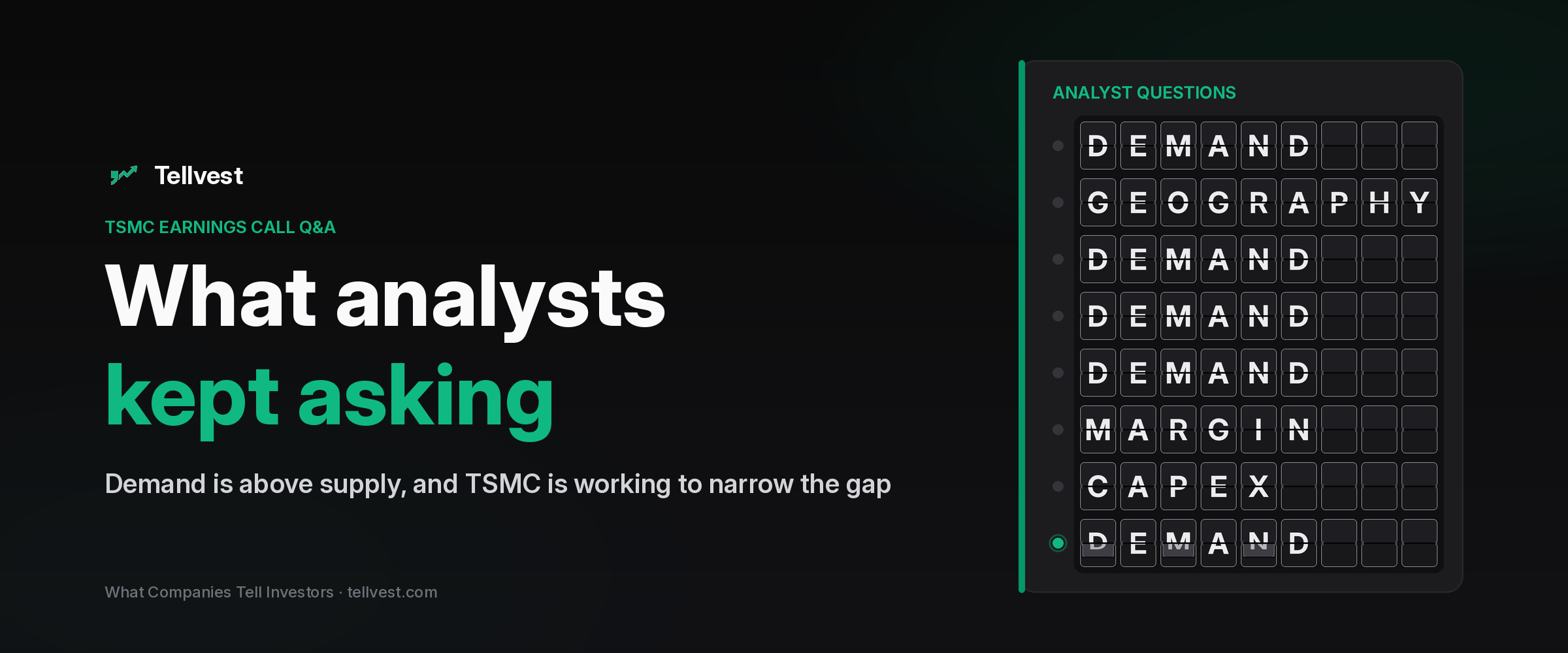
On TSMC's July earnings call, analysts spent more of their questions on capex than on anything else. In October, demand came back on top, even as C.C. Wei told them "the demand actually is still far above our capability today to supply." This post follows the TSMC earnings call Q&A quarter by quarter, using Tellvest's classification of every analyst question by topic, and sets management's own words beside it. One call read alone looks like a snapshot. Eight in a row show a pattern: analysts keep asking how big demand is and how fast TSMC can build for it.
How Tellvest sorts TSMC earnings call questions

Tellvest tags every analyst question on a call with one or more topics, such as Demand, Capex Investment or Margin, and marks whether the analyst pushed back. A question can carry more than one topic, so topic counts can add up to more than the number of questions. Topic labels are Tellvest's classification, not TSMC's. Quotes below are labeled by who said them: management, an analyst, or a Tellvest summary.
Eight quarters of the same pressure
By Tellvest's count, Demand was the top topic on four of the five calls from late 2024 through late 2025. It drew 10 questions in the fourth quarter of 2024, 12 in the second quarter of 2025, 7 in the third (tied with Cloud & AI) and 8 in the fourth. The exception was the first quarter of 2025, when Geographic Expansion led with 6.
On the January 2026 call, covering the fourth quarter, one analyst asked: "could that mean that we start to see supply and demand more in balance in 2027?" Tellvest's summary of that call notes management guided to margin dilution from overseas fabs and from the early 2-nanometer ramp.
In April, Demand dropped to 3 questions. Margin and Competitive Dynamics tied at the top with 4 each, and pushback peaked: Tellvest scored 19% of the 16 questions from 8 analysts as challenging. Gokul Hariharan of JPMorgan asked: "what is your expectation that how long this supply constraint is likely to last?"
July: capex questions take over
On the July 16 call, Capex Investment led for the first time, with 9 questions against 7 for Demand. Eleven analysts asked 21 questions, and Tellvest scored 10% as challenging.
The numbers explain why. Management raised its capital budget: TSMC said it expects full year 2026 spending "between $60 billion and $64 billion," and full year 2026 revenue growth "slightly above 40% year-over-year." Analysts pressed on the gap between demand and what TSMC can build. Rob Sanders of Deutsche Bank asked whether "the unconstrained demand for 3 nm and below is sort of 30%-50% above your ability to supply." A UBS analyst asked how aggressive TSMC is planning for capex "beyond 2026."
October: demand back on top
On the October 15 call, Demand took back the top spot with 6 of 19 questions from 8 analysts. Capex Investment fell from 9 to 4. Competitive Dynamics drew 5. Pushback was the lowest of 2026: Tellvest scored 1 of 19 questions, or 5%, as challenging. That one question asked whether adopting High NA EUV around 2030, later than competitors, puts TSMC at a technology disadvantage.
Management raised the growth line again, from "slightly above 40%" in July. In prepared remarks: "we now expect our full year 2026 revenue growth to be around 44% year-over-year in U.S. dollar term."
Asked whether AI demand is shifting toward CPUs, C.C. Wei said: "I want to emphasize again, in our judgment, we consider all the parameter, and the demand actually is still far above our capability today to supply. We are working very hard to narrow the gap. That's all I can say."
He gave a similar line to an earlier question: "we still think the demand is higher than the supply, and we are working very hard to narrow the gap." Asked about the AI accelerator growth rate, he said: "We did not see any sign of slowdown. Whether it is a high 50 CAGR, it does not matter. It probably will be higher."
What changed, and what didn't
The pressure did not change. Across eight calls, analysts kept asking the same two things: how big is demand, and how fast can TSMC build? The emphasis moved. In July, the questions leaned toward the build: capex, capacity and the gap analysts were sizing themselves. In October, they leaned back to demand, and management's answer was short and repeated: demand is above supply, and TSMC is working to narrow the gap. Read the answer, not the headline.
The next update is the January call.
FAQ
What did analysts ask TSMC on the October 2026 earnings call? By Tellvest's classification, Demand was the top topic, with 6 of 19 questions from 8 analysts. Capex Investment drew 4.
What changed from July? In July, Capex Investment led with 9 questions and Demand had 7. In October, Demand led and Capex fell to 4.
What did TSMC say about demand vs supply? C.C. Wei said "the demand actually is still far above our capability today to supply. We are working very hard to narrow the gap."
How often did analysts push back? Tellvest scored 5% of October questions as challenging, down from 10% in July and 19% in April.
How to follow TSMC calls yourself
- Open the TSMC company page to see the Q&A topics by quarter and the analyst questions. Prior quarters are free, and the newest quarter is part of Pro.
- Compare management's lines on the same topic from one call to the next.
- For the cross-company view, read AI capex: what companies said on earnings calls.
How to grade earnings call analysts explains the challenge rate. New to the format? Start with what is an earnings call.
Descriptive analysis, not investment advice. Quotes are short excerpts from public earnings calls.
Related: Blog, How to follow earnings without reading every transcript.