Start 30 days free, no card. Full Pro access for a month, then decide. Start free
What is an earnings call?
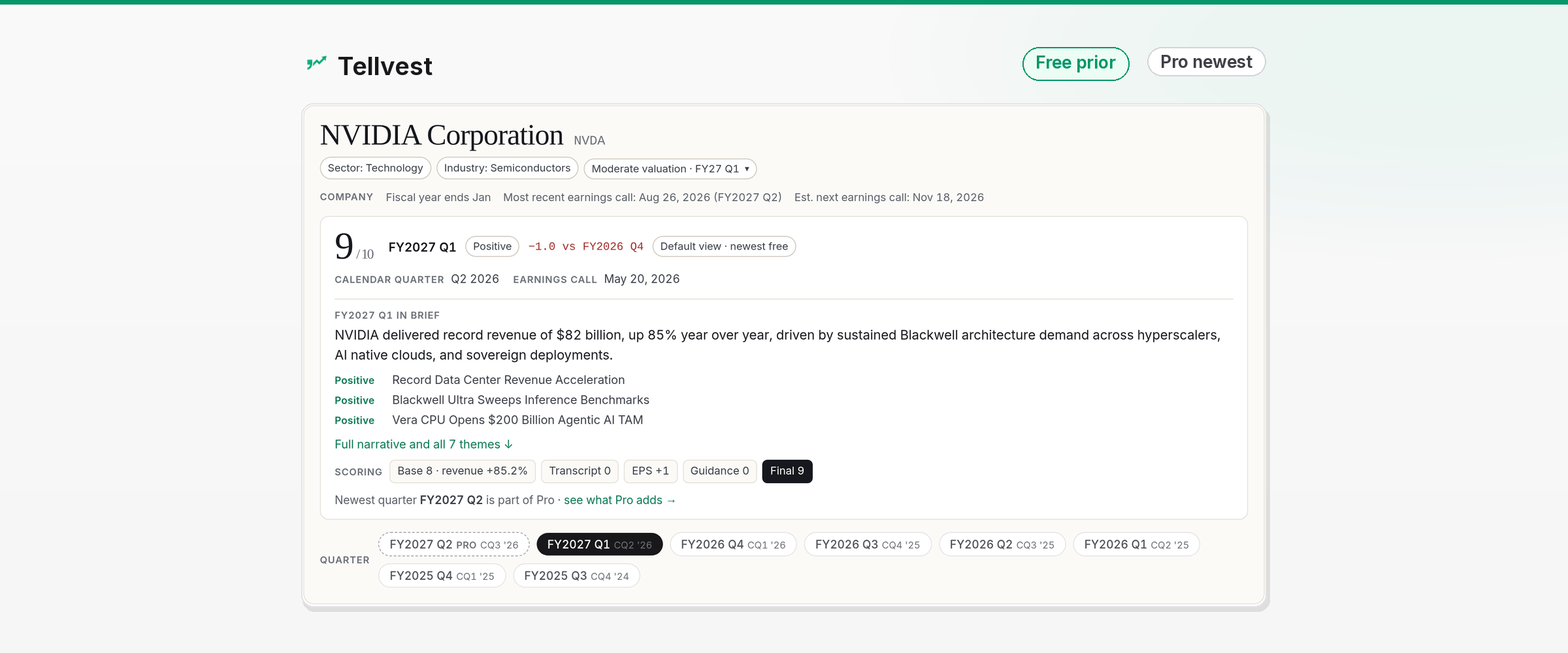
An earnings call is a conference call a public company holds after it reports quarterly results. Senior executives, usually the CEO and CFO, walk through the numbers and the outlook. Then analysts ask them questions. Anyone can usually listen live by phone or webcast, and a replay often stays up on the company's investor relations site.
You hear "on the earnings call" in headlines every quarter. But calls run long, the audio sits on a page you have to find, and the transcript is a wall of text. Headlines keep the numbers and drop the tone, the guidance changes, and the hard questions. This guide covers what happens on a call, who speaks, where to find it, and a short way to follow one.
Tellvest is descriptive analysis for research and informational purposes only. It is not investment advice.
When do earnings calls happen?
Usually once a quarter, soon after the company releases its results, often the same day. The SEC's own model under Regulation FD runs in that order: a press release with the results, advance notice of the call with the date, time, and how to join, then a call investors can listen to by phone or webcast.
Many companies report in the weeks after each calendar quarter ends, which is why people talk about "earnings season." Companies with a different fiscal year report on their own schedule.
To see when a company you follow reports next, open Companies. The list shows each company's most recent call and next call, and every company page shows an estimated next earnings call date. Confirm the exact time on the company's investor relations site.
Who is on the call?
- An operator or investor relations lead opens the call, often with a short legal notice about forward-looking statements.
- The CEO and CFO usually give the prepared remarks. Other executives sometimes join.
- Sell-side analysts from banks and research firms ask the questions. See how to grade earnings-call analysts for how their questions compare.
- Everyone else, including individual investors and reporters, can usually listen but not ask questions.
Prepared remarks vs Q&A
A call usually has two parts, and they tell you different things.
Prepared remarks are scripted. Management covers the quarter's results, guidance, and the themes it wants you to hear. This is the company's message.
Q&A is where analysts push. They ask about weak spots, guidance, and anything the script skipped. Answers are less rehearsed, so this is where you see how management handles pressure.
On a Tellvest company page, both parts have their own layers:
- For prepared remarks: As stated by management pulls quotes on EPS, revenue, guidance, and a key metric, and Key Themes lists the call's main themes, each tagged positive, negative, or mixed.
- For Q&A: Analyst Q&A lists each analyst, their firm, and their question, tags each question as neutral or challenging, and shows the challenge rate (the share of questions that push back). Q&A Topics shows what analysts asked about most.
Quotes are exact excerpts from public transcripts. See how to read a company earnings-call score for a walkthrough of the page, or what companies say about the consumer on earnings calls to see one topic tracked across many calls.
Where to find earnings call audio and transcripts
Audio and webcast. Go to the company's investor relations site, usually linked as "Investors" on its homepage. The events page has the live webcast and, often for a limited time, the replay. Phone dial-in details are usually in the press release that announces the call.
Transcripts. Some companies post a transcript on their investor relations site. Third-party transcript providers also publish them. What is available varies by company.
Tellvest. Tellvest reads public earnings-call transcripts and turns each call into a score, themes, exact management quotes, analyst questions, and Mentions. Each answer gets a Tellvest summary with a link to the transcript at that point in the call.
How to follow an earnings call in 3 steps
- Find the date. Check Next call on Companies or the company page, then get the webcast link from the company's investor relations site.
- Read the score and structured layers first. Open the company page, for example NVIDIA, Costco, or Uber, and on a free prior quarter read the 1 to 10 score, Key Themes, management quotes, and Analyst Q&A.
- Open the transcript or replay only where it matters. Start with the Analyst Q&A questions where analysts pushed hardest. Each one opens a short Tellvest summary of management's answer, with a link to that moment in the call. For the full exchange behind a score change, follow that link into the transcript. For the audio replay, use the company's investor relations site.
For the full path, including economy and analyst views, see how to follow earnings without reading every transcript.
Where Tellvest fits
Tellvest reads public earnings calls for 500+ U.S. companies and has analyzed 4,200+ calls. Each call gets a sentiment score from 1 to 10 built on a published rubric: a base from year-over-year GAAP revenue growth, then transcript, EPS, and guidance adjustments. See how to get an earnings-call sentiment score and About for the rubric and sources.
Beyond the single call:
- Mentions shows what companies said about each other on their calls, quoted verbatim from public transcripts. See how to read cross-company earnings Mentions.
- Earnings Pulse is the market-wide read each quarter. See how to read the Earnings Pulse.
- Economy has the Economic Sentiment Index, a composite across analyzed companies. See how to read the Economic Sentiment Index.
- Pre-earnings briefs, a Pro feature, help you prepare before a call. See how to use pre-earnings briefs.
Prior quarters are free to browse, and the newest quarter is part of Pro. See how to browse earnings scores without Pro or Pricing. For the product overview, see earnings-call intelligence.
What is an earnings call? Common questions
Are earnings calls public?
Usually, yes. Companies are not required to hold an earnings call. But under the SEC's Regulation FD, a company that shares material information with analysts or certain investors must also share it with the public. The SEC's model for a scheduled earnings release is a press release, advance notice of the call, and a call anyone can listen to by phone or webcast. That is why you can usually listen without being an analyst or a shareholder.
When do companies hold earnings calls?
Usually once a quarter, soon after they release results, often the same day. The Next call column on Companies and the estimated next earnings call date on each company page show when a company is expected to report.
Who speaks on an earnings call?
Usually the CEO and CFO, sometimes other executives, plus an operator or investor relations lead who runs the call. Sell-side analysts ask the questions during Q&A.
What is the difference between prepared remarks and Q&A?
Prepared remarks are the scripted part, where management presents results, guidance, and themes. Q&A is the unscripted part, where analysts question management on what was said or left out.
How do I listen to an earnings call?
Go to the company's investor relations site and find the events page. It usually has the live webcast and, often for a limited time, a replay. The press release announcing the call usually lists the date, time, and dial-in details.
Where can I find earnings call transcripts?
Some companies post transcripts on their investor relations site, and third-party providers also publish them. On a Tellvest company page you get the call's score, themes, exact management quotes, and the analyst questions. Each analyst question shows a Tellvest summary of the answer and links to the transcript at that point in the call.
How long is an earnings call?
Often about an hour, though it varies by company.
Start with a company you follow
Pick a company and read its free prior-quarter score before you open the next call.
See the Economic Sentiment Index or read the Earnings Pulse.