October 15, 2026
Bank earnings Q3 2026: which big banks raised, held or cut their guide?
Bank earnings Q3 2026: did JPMorgan, Wells Fargo, Citi and BofA raise, hold or cut their July NII guides? Plus what Goldman and Morgan Stanley said.
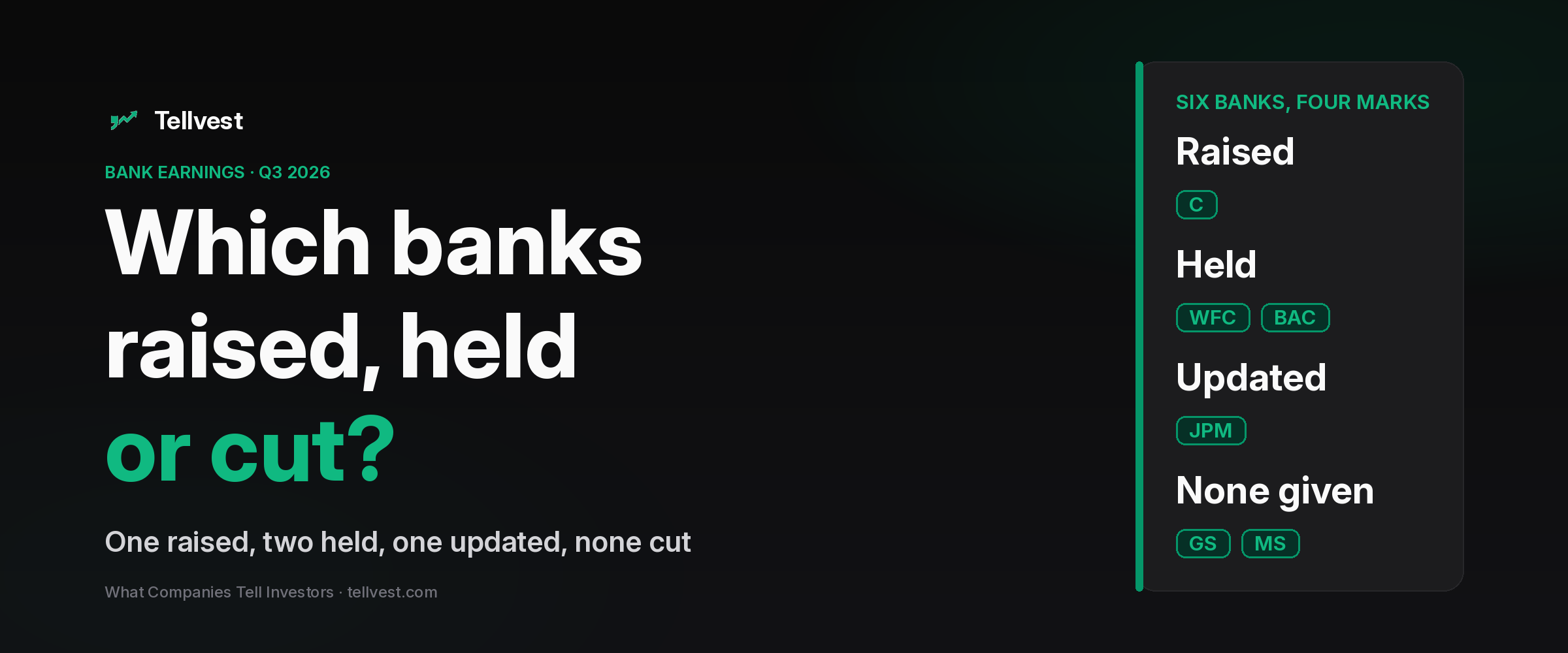
Bank earnings week packed six big bank calls into two days, October 13 and 14, and most headlines graded them against analyst estimates. This scorecard uses a cleaner test: did each bank do what it said it would? We hold JPMorgan Chase, Wells Fargo, Citigroup and Bank of America to the full-year net interest income guide each set itself on its July call, in its own unit, and check what each said in October. Goldman Sachs and Morgan Stanley give no formal guide, so we show what they said instead.
How we scored bank earnings: raised, held or cut

Each bank is measured only against its own most recent full-year guide, in the unit the bank uses. JPMorgan and Wells Fargo guide net interest income in dollars. Bank of America and Citi guide it as a growth rate. We never convert one into the other.
- Raised: the bank moved its own range or point estimate up.
- Held: the bank reiterated it, in words like "still expect" or "continue to."
- Cut: the bank moved it down.
- Updated: the bank changed how it states the guide, so the October line cannot be read as up or down on its own.
- Withdrawn: the bank stopped giving it.
- None given: the bank does not issue this guide. That is a policy, not a miss.
The baseline is the last guide each bank set before its October call.
The scorecard at a glance
| Bank | Call day | NII guide: July to October | Mark | Other guide lines in October | What they said on credit | Company page |
|---|---|---|---|---|---|---|
| JPMorgan Chase | Oct 13 | About $96.5 billion full-year NII ex-Markets in July. In October, a fourth-quarter figure instead: about $25.5 billion ex-Markets, about $28 billion total | Updated | Card net charge-off rate "approximately 3.2%," held. Fourth-quarter expense about $27.5 billion | Credit costs $2.7 billion, including a $539 million net reserve build | See the Q3 score on the JPM page (Pro) |
| Wells Fargo | Oct 13 | $50 billion, plus or minus, to "$50 billion, plus or minus" | Held | Noninterest expense about $55.7 billion, held | Net loan charge-off ratio 38 basis points; allowance coverage "relatively stable" | See the Q3 score on the WFC page (Pro) |
| Citigroup | Oct 13 | High end of 5% to 6% growth to "the mid- to high-6% range" | Raised | ROTCE to "above 11%" (Raised); July had 10-11%, October described prior as high end of 10-11% or a bit better | Cost of credit $2.6 billion, including a $369 million net reserve build | See the Q3 score on the C page (Pro) |
| Bank of America | Oct 14 | Upper end of 6% to 8% in July, then raised to 7% and to 8%, to "approximately 8%" | Held | 2027 NII growth "8% or more" | Provision about $1.3 billion, lower than Q2; net charge-off ratio 44 basis points | See the Q3 score on the BAC page (Pro) |
| Goldman Sachs | Oct 13 | None given | None given | Backlog "remains very robust" | Provision for credit losses $368 million | See the Q3 score on the GS page (Pro) |
| Morgan Stanley | Oct 14 | None given | None given | "We expect a modest increase in the fourth quarter" for NII; "banking pipelines remain high" | Institutional Securities provisions $141 million, "driven primarily by portfolio growth" | See the Q3 score on the MS page (Pro) |
One raised, two held, one updated, none cut. Both banks without a guide still told investors where they thought the business was heading. The newest quarter on each company page is part of Tellvest Pro. Earlier quarters are free.
Tuesday: JPMorgan, Goldman Sachs, Wells Fargo and Citi earnings calls
JPMorgan earnings call: guide restated as a fourth quarter
In July, JPMorgan guided full-year NII ex-Markets to about $96.5 billion. In October it changed the format: "I am going to update the full year guidance by giving you the fourth quarter." Management expects "fourth quarter NII ex-markets to be approximately $25.5 billion and fourth quarter total NII to be about $28 billion." The implied full year was not spoken; it is on the slide. So we mark this Updated rather than guess at raised or cut. The card guide held: "we continue to expect the card net charge off rate to be approximately 3.2%." Credit costs were $2.7 billion, with net charge-offs of $2.2 billion and a net reserve build of $539 million. Looking further out, management put 2027 NII ex-Markets at "approximately $107 billion."
See the Q3 score on the JPMorgan company page (Pro)
Wells Fargo earnings call: held at $50 billion
Wells Fargo kept its word on both numbers. "We still expect net interest income for full year 2026 to be $50 billion, plus or minus," management said, and "we continue to expect 2026 noninterest expense to be approximately $55.7 billion." Fourth-quarter NII is expected at about $13 billion. The net loan charge-off ratio was 38 basis points of average loans, down from a year ago, though commercial charge-offs rose 8 basis points from the second quarter to 18. Allowance coverage was "relatively stable compared with the second quarter."
See the Q3 score on the Wells Fargo company page (Pro)
Citi earnings call: raised, and built reserves
Citi is the one raise. NII ex-Markets growth is now expected "in the mid- to high-6% range" for the year, which management called an upgrade "versus the original beginning of the year, 5-6%." The NII guide had already moved "a few weeks ago" to the high end of 5% to 6%, so that is the starting point. The returns target moved up too, to "ROTCE above 11% for the full year." On the October call, management described the prior guide as "the high end of 10-11% or a bit better than 11%" when it lifted; July's own wording had been 10-11%. On credit, "cost of credit was $2.6 billion which included a firm wide net reserve build of $369 million." About 86% of card balances are to borrowers with FICO scores of 660 or higher.
See the Q3 score on the Citigroup company page (Pro)
Goldman Sachs earnings: no guide, a busy backlog
Goldman Sachs gives no formal NII or credit guide, so there is nothing to mark. Instead, management said it entered the quarter with "our highest backlog in 5 years," and that after strong accruals the backlog "remains very robust." Firm-wide NII was $3.8 billion and the provision for credit losses was $368 million.
See the Q3 score on the Goldman Sachs company page (Pro)
Wednesday: Bank of America and Morgan Stanley
Bank of America: held at about 8%
In July, Bank of America pointed to the upper end of its 6% to 8% range. The guide was then raised, first to 7% and then to 8%. In October: "We still expect to hit that full-year revised NII growth guidance of approximately 8%." October held it at about 8%, so we mark it Held. Management also set 2027 NII growth at "8% or more." Third-quarter NII was $16.6 billion on a fully taxable-equivalent basis, up 8% from a year ago. Reported expense of $19.7 billion included a $1.2 billion regulatory settlement charge. Provision was about $1.3 billion, lower than the second quarter, the net charge-off ratio was 44 basis points, and the card loss rate improved to 3.22%.
See the Q3 score on the Bank of America company page (Pro)
Morgan Stanley: no guide, and a July outlook that did not play out
Morgan Stanley gives no formal NII or credit guide. Its July outlook, on the Q2 call: "For the third quarter, we expect a modest sequential increase in NII." In October, NII came in at $2.2 billion, "down modestly as deposits grew and the mix shifted," with deposits up nearly $30 billion from the prior quarter. For NII in October, management said: "we expect a modest increase in the fourth quarter." That was an outlook, not a formal guide, so it does not get a mark. Management said "banking pipelines remain high" and "robust and diversified across product, sectors, and regions."
See the Q3 score on the Morgan Stanley company page (Pro)
The banks with no guide: what Goldman Sachs and Morgan Stanley offered instead
Neither bank issues formal earnings, revenue or NII guidance, so "None given" is accurate, not a penalty. Both pointed to deal activity instead: Goldman to its backlog, Morgan Stanley to its banking pipelines.
Bank loan loss reserves: building or releasing?
In October, the two banks that stated a direction were building. JPMorgan built a net $539 million and Citi a net $369 million. Wells Fargo and Bank of America did not state a reserve direction on their calls. Bank of America's provision fell to about $1.3 billion. A reserve build means a bank is setting aside more for loans it expects could go bad. A release means it needs less. Neither is a forecast from us.
Where analysts pushed back
Tellvest classifies every analyst question on each call and shows how often analysts challenged management. Across all quarters Tellvest has analyzed for each bank, Citi draws the most pushback at 16% of questions, followed by JPMorgan at 13%, Bank of America at 12%, Morgan Stanley at 10%, Goldman Sachs at 8% and Wells Fargo at 7%. These are company-level rates, not single-call rates. They show where analysts tend to press, not who was right. How to grade earnings call analysts explains the measure.
What bank earnings watchers should take from October
The numbers tell you who held. The words tell you how confident they sound. No guided bank cut. Citi raised, Wells Fargo and Bank of America held, and JPMorgan changed how it states the number. JPMorgan and Citi built reserves anyway. Read both before you take a headline's word for it.
FAQ
When did the big banks report Q3 2026 earnings? JPMorgan, Wells Fargo, Citi and Goldman Sachs reported on October 13, 2026. Bank of America and Morgan Stanley reported on October 14.
What is net interest income and why do banks guide it? Net interest income is what a bank earns on loans and securities minus what it pays on deposits and borrowing. It is the largest revenue line for most big banks, so many set a full-year target for it.
What is a charge-off? A charge-off is a loan the bank no longer expects to collect and writes off its books. The charge-off ratio compares those losses with average loans.
What does it mean when a bank builds loan loss reserves? It sets aside more money for loans it expects could go bad. A release is the opposite.
Did JPMorgan raise its guidance? Not in a way we can mark. In October JPMorgan gave a fourth-quarter NII figure instead of a full-year one and the implied full year was not spoken; it is on the slide. In July it had raised full-year NII ex-Markets from about $95 billion to about $96.5 billion.
Do Goldman Sachs and Morgan Stanley give earnings guidance? Neither gives formal earnings or revenue guidance. Both share outlook comments, such as backlogs and banking pipelines.
How to follow bank earnings yourself
- Use the scorecard above to see who raised, held or cut the guide it set itself.
- Open each bank's company page for management's own words and the analyst questions. Prior quarters are free, and the newest quarter is part of Pro.
- Use the Economic Sentiment Index or the Earnings Pulse to see what companies are saying across sectors.
For what companies across sectors said about shoppers, see what companies say about the consumer on earnings calls.
Descriptive analysis, not investment advice. Quotes are short excerpts from public earnings calls.
See the Economic Sentiment Index
Related: Blog, What retailers said they did with tariff refunds, AI capex: what companies said on earnings calls, How to follow earnings without reading every transcript.